NALGENE 187-1345 Syringe Filter Sterile Ptfe 0.45UM 100/PK
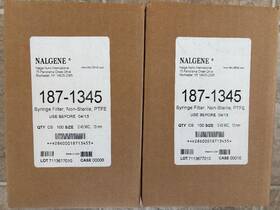
( Brand: Nalgene ), ( Manufacturer Part Number: 187-1345 ), ( Part Type: Filter ), ( Country Of Origin: United States )
Review NALGENE Two Syringe Filter Non sterile Ptfe 100/pk Exp Free Ship
The **Nalgene 187-1345 Syringe Filter** is a high-performance, disposable filtration system designed for precision laboratory applications where reliability and consistency are paramount. Engineered with **polytetrafluoroethylene (PTFE)**, a chemically inert and thermally stable polymer, this filter offers exceptional resistance to a wide range of solvents, acids, bases, and organic compounds, making it ideal for demanding filtration tasks in biochemistry, molecular biology, pharmaceutical research, and analytical chemistry. The **0.45-micron pore size** ensures effective removal of bacteria, particulate matter, and fine debris, providing a sterile-grade barrier for sample clarification, buffer preparation, and solution purification without compromising the integrity of sensitive biomolecules or delicate compounds. Each filter is housed in a **sterile, low-protein-binding polypropylene housing**, which minimizes adsorption and ensures minimal sample contamination, while the **Luer-Lok compatibility** allows for seamless integration with standard syringes, pipettes, and other laboratory instrumentation. Packaged in a convenient **100-unit case**, this filter offers exceptional value for high-throughput laboratories, research facilities, and quality control environments where efficiency and reproducibility are critical. Whether used for filtering cell culture media, preparing protein solutions, or processing complex biological samples, the Nalgene 187-1345 delivers consistent performance with every use, reinforcing its reputation as a trusted tool for scientists who demand precision and dependability in their filtration processes.
**Pros and Cons of buying a Nalgene 187-1345 Syringe Filter (Non-Sterile, PTFE, 0.45 m, 13 x 100/pk)**
### **Pros:**1. **High Filtration Efficiency** The 0.45 m pore size effectively removes bacteria, particles, and contaminants, making it suitable for general laboratory filtration tasks such as sample preparation, cell culture media sterilization (when used with sterile technique), and liquid clarification.
2. **Durable and Reliable Material** PTFE (polytetrafluoroethylene) is chemically inert, resistant to most solvents, acids, and bases, and maintains stability across a wide temperature range. This ensures consistent performance in various applications.
3. **Convenient Packaging** The pack of 100 filters provides cost efficiency for bulk use, reducing the need for frequent reorders, which is ideal for laboratories, research facilities, or industrial settings with high filtration demands.
4. **Compatibility with Common Equipment** The 13 mm diameter fits standard syringe filters, making it compatible with most laboratory syringes, pipettes, and filtration setups without requiring additional adapters.
5. **Non-Sterile but Cost-Effective** Since these filters are non-sterile, they are significantly cheaper than sterile alternatives, making them a practical choice for applications where sterility is not critical (e.g., sample filtration, buffer preparation, or non-critical liquid processing).
6. **Versatile Applications** Beyond basic filtration, these filters can be used for:- Removing particulate matter from solutions.
- Preparing samples for chromatography or spectroscopy.
- Clarifying biological samples (e.g., cell culture media, buffers).
- Filtering water or solvents in laboratory procedures.
7. **Easy to Use** The design is straightforward: attach to a syringe, draw or push liquid through, and discard. No complex assembly is required, saving time and reducing user error.
---
### **Cons:**1. **Non-Sterile Design** The primary limitation is that these filters are **not sterile**, meaning they cannot be used for applications requiring sterile filtration (e.g., sterile cell culture media, pharmaceutical preparations, or aseptic techniques). For sterile applications, you would need to purchase a sterile version or use additional sterilization methods (e.g., autoclaving, though PTFE may degrade under high heat).
2. **Limited Temperature Range** While PTFE is stable under moderate temperatures, prolonged exposure to high heat (above 260 C) can degrade the material. This restricts their use in high-temperature sterilization processes.
3. **Potential for Leakage** Like all syringe filters, improper sealing or damaged filters can lead to leaks, compromising filtration integrity. Users must ensure proper handling and inspection before use.
4. **Single-Use Only** These filters are designed for one-time use. Reusing them can introduce contamination or clogging, reducing efficiency and potentially compromising results.
5. **No Built-In Sterility Assurance** Unlike sterile filters, there is no guarantee of microbial contamination absence unless the user implements additional sterilization steps (e.g., filtering through a separate sterile filter afterward).
6. **Chemical Compatibility Limitations** While PTFE is highly resistant to most chemicals, it may degrade in highly oxidative environments (e.g., strong oxidizing agents like potassium permanganate or concentrated nitric acid) or under prolonged exposure to certain solvents.
7. **No Barrier to Viruses or Smaller Particles** The 0.45 m pore size does not filter viruses or nanoparticles, so these filters are unsuitable for applications requiring viral removal (e.g., some biopharmaceutical processes).
---
### **Conclusion:**The Nalgene 187-1345 syringe filter is a **practical, cost-effective choice for non-sterile filtration tasks** in laboratories, research, or industrial settings where bacterial removal and particulate filtration are required but sterility is not. Its durability, chemical resistance, and bulk packaging make it a reliable option for routine use. However, its **non-sterile nature and lack of viral filtration** limit its applicability to sterile or high-purity environments.
### **Recommendation:** - **Buy this product if:**- You need a high-volume, cost-effective filter for non-sterile applications (e.g., sample preparation, buffer clarification, or general liquid filtration).
- Your workflow does not require sterile conditions (e.g., non-critical cell culture media, solvent filtration, or environmental sample processing).
- You are working with chemicals compatible with PTFE and do not need viral or nanoparticle removal.
- **Avoid this product if:**- You require **sterile filtration** (e.g., for pharmaceuticals, sterile cell culture, or medical applications). In this case, opt for a sterile version or use an additional sterilization step.
- Your application demands **viral or nanoparticle filtration** (consider filters with smaller pore sizes like 0.2 m).
- You frequently work with **highly oxidative chemicals** that may degrade PTFE.
- **Alternative Considerations:**- For sterile applications, purchase the **sterile version** of this filter or a brand like Millipore or Pall.
- If you need viral filtration, consider **0.2 m filters** (e.g., Nalgene 187-1344 or similar).
- For high-temperature applications, explore filters made from materials like polypropylene or nylon, which may have better thermal stability.
In summary, this filter is well-suited for **general laboratory filtration needs where sterility is not a concern**, but users should carefully assess their specific requirements before purchasing.
Details:
part #: 1871345 prices
- $58.50-$299.50
specifications plasticwarelabsuppy:
- brand: Nalgene
- mpn: 187-1345
- part type: Filter
- country of origin: United States
returns plasticwarelabsuppy:
- policy: No Returns
shipping plasticwarelabsuppy:
- type: Calculated
- service: USPS Ground Advantage
- cost: $0.00
- class: Standard
- transit: 4-9 Days
- carrier: USPS
seller plasticwarelabsuppy:
- # reviews: 1663
- city: Herndon, Virginia
- rating: 100.0%
offer plasticwarelabsuppy:
- best offers: True
- quantity: 1
- started: March 29, 2026
- sold: 0
- options: Ship-to-home
- availability: In Stock
general plasticwarelabsuppy:
- Medical, Lab Dental Supplies > Glassware Plasticware > Other Medical Lab Glassware
- condition: New
payments plasticwarelabsuppy:
- other
- credit card: Diners-club
- wallet: Apple-pay
Nalgene 187-1345 Is Similar To:
- 097403a Thermo Scientific Nalgene Sterile Disposable Filter Units (30.5% similar) Upper chamber separates from receiver for easy access to screw cap eliminates pH shift in bottle provide longer life stored fluids receiver is an ideal filtrate storage vessel. Nalgene rapid-flow membrane support system provides fast flow and high throughput...(May 23rd, 2018)
- 10026-086 Vwr Nalgene Plastic Filter Unit Pes Membrane (37.1% similar) New old stock...(April 23rd, 2018)
- 121-0020 Nalgene Ml Filter Unit Um Case Of Cat (36.4% similar) This listing is set up to ship in one flat rate box. Some are labeled with use by dates in the mid 90'S, its unclear to me if that's from manufacturer. I have these either by the carton of 12 or oem case which is 6 cartons pieces 72 units total, see my other listings. These are essentially new old ...(March 1st, 2018)
- 127-0020 Nalgene Polystyrene With Cellulose Nitrate Lab Filter Unit Micron (32.5% similar) Product detail capacity: 150ML cellulose nitrate CNN membrane diameter: 50MM pore size. This brave box gave its life to protect its contents. Return guarantee every effort has been made to accurately describe all merchandise offered for offer. In fact, its kind of our thing...(May 15th, 2018)
- 156-4020 Nalgene Rapid Flow Filter (26.7% similar) 2 graduations on both uppers and receivers leak proof turn threaded screw closure provided for receiver yellow collar case of 12MANUFACTURER: Thermos fisher Nalgene manufacturer part no. Upper capacity: 500ML receiver 500MLMATERIAL: polystyrene housing with a SPCA membrane membrane diameter: 75MM ...(October 20th, 2017)
- 157-0020 Nalgene Rapid Flow Sterile (31.4% similar) We combine shipping costs wherever possible. Please feel free to for an accurate shipping quote or request alternate method. Please prior to sale for an accurate shipping quote. Nalgene rapid flow sterile disposable filter unit 250ML RR inventory location: PS2 17-3 this offer is for: lot of 2 ...(July 11th, 2017)
- 161-0020 Nalgene Plastic Filter Units Sfca Membrane (32.1% similar) ...(March 26th, 2019)
- 189-2000 Nalgene Plastic Syringe Filter Polyethersulfone Sterile (42.7% similar) New old stock...(July 18th, 2018)
- 190-2020 Gelman Nalgene Syringe Filter (35.5% similar) New and original box no chips free shipping in the us...(June 7th, 2017)
- 191-2045 Nalgene Pack 50 Syringe (28.8% similar) O box address this is the best deal out there. Pack 50 Nalgene syringe filters 25MM will have to be signed for unless arrangements been made before shipping. Will have to be signed for unless arrangements been made before shipping. Take a good look be the bidder-be fetter don't miss this one need ...(August 2nd, 2017)
- 199-2020 Nalgene Pack 40 Syringe (28.8% similar) Review the pictures for included elements and condition of item...(May 9th, 2017)