CELLTREAT 230440 Culture Tube Dual Cap Sterile 14ML
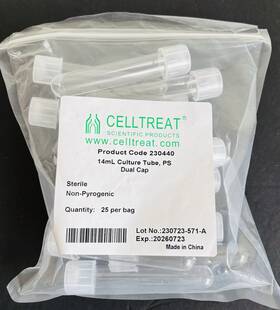
( Brand: Celltreat ), ( Manufacturer Part Number: 230440 ), ( Part Type: Tube Cap )
Review CELLTREAT 14ml Culture Tube And Dual Cap Ps Sterile
The **CellTreat 230440 14 mL Dual-Cap Sterile Culture Tube** is a precision-engineered laboratory consumable meticulously designed to meet the rigorous demands of cell culture, microbiology, and molecular biology applications. Crafted from high-quality, borosilicate glass, this tube offers exceptional chemical resistance, thermal stability, and durability, ensuring consistent performance across a wide range of experimental conditions. The dual-cap system comprising a standard screw cap and a secondary, secure sealing mechanism provides dual-layer protection against contamination, evaporation, and accidental spills, making it ideal for long-term storage, subculturing, or sensitive assays where sterility is paramount. With a capacity of 14 mL, the tube strikes an optimal balance between volume flexibility and ease of handling, accommodating everything from small-scale cell suspensions to medium preparations without compromising precision. The sterile, non-pyrogenic design adheres to stringent industry standards, guaranteeing compatibility with sterile technique protocols and minimizing the risk of introducing extraneous contaminants that could compromise experimental integrity. Whether used in adherent cell culture, suspension cell maintenance, or sample preservation, this tube s smooth, rounded base and precise dimensions facilitate uniform mixing and easy transfer, while its clear, uncolored glass allows for visual inspection of contents without interference. Additionally, the tube s compatibility with standard laboratory equipment, including centrifuges, incubators, and automated liquid handlers, ensures seamless integration into existing workflows. For researchers prioritizing reliability, sterility, and versatility, the **CellTreat 230440** stands as a dependable choice, combining functionality with the robustness required for high-stakes biological and biochemical studies.
**Pros and Cons of buying a CellTreat 230440 (14 mL Culture Tube with Dual Cap, Sterile)**
### **Pros**
1. **Sterility and Quality Control** The product is marketed as sterile, which is critical for cell culture applications to prevent contamination. Proper sterilization reduces the risk of introducing microbial or particulate contaminants that could compromise experiments.
2. **Dual-Cap Design** The dual-cap system (likely a screw cap and a secondary seal) enhances functionality by allowing secure sealing while also providing an airtight or semi-permeable option. This can be useful for gas exchange (e.g., CO incubation) or preventing evaporation during long-term storage.
3. **Material Suitability** CellTreat tubes are typically made from polystyrene or similar biocompatible materials that are chemically inert and resistant to common cell culture reagents (e.g., PBS, DMEM, FBS). This minimizes leaching or adsorption of components that could interfere with cell growth or assays.
4. **Standardized Volume (14 mL)** The 14 mL size is practical for many cell culture applications, including seeding, expansion, or small-scale experiments. It strikes a balance between scalability and ease of handling compared to larger flasks or smaller microcentrifuge tubes.
5. **Compatibility with Common Equipment** These tubes are designed to fit standard laboratory equipment, such as incubators, centrifuges, and shakers, without requiring specialized adapters. This ensures versatility in workflows.
6. **Brand Reputation** CellTreat is a well-known supplier of cell culture products, often preferred for their reliability and adherence to industry standards. Their products are widely used in research and clinical settings, which can be reassuring for buyers.
7. **Cost-Effective for Small-Scale Use** Compared to multi-well plates or larger culture flasks, these tubes offer a cost-effective option for low-volume or pilot experiments. They reduce waste when only small amounts of cells or media are needed.
8. **Easy Sterilization and Reuse (If Appropriate)** While typically single-use, some users may autoclave or sterilize these tubes for reuse in non-critical applications (though this is not recommended for primary cell cultures or sensitive assays). Proper sterilization protocols can extend their utility in controlled environments.
9. **Clear Labeling and Documentation** CellTreat products often come with detailed documentation, including batch numbers, expiration dates, and compatibility notes, which aids in traceability and quality assurance.
10. **Versatility in Applications** Beyond standard cell culture, these tubes can be used for:- Short-term cell storage (e.g., cryopreservation vials with freezing medium).
- Small-scale biochemical assays (e.g., protein extraction, DNA/RNA purification).
- Storage of cell lines or reagents that require sterile conditions.
---
### **Cons**
1. **Single-Use Nature** Most sterile culture tubes are designed for one-time use to prevent cross-contamination. Disposing of them after use can be costly and environmentally impactful, especially in high-throughput labs.
2. **Limited Surface Area for Adherence** Unlike T-flasks or dishes with a larger surface area, these tubes provide minimal space for cell attachment. Cells may clump or grow unevenly, which can affect experimental outcomes (e.g., imaging, confluence-based assays).
3. **No Built-In Ventilation for Gas Exchange** While the dual cap may allow some gas exchange, it is not optimized for CO incubation like vented flasks. Cells requiring CO (e.g., mammalian cells) may need additional measures (e.g., loose caps or specialized incubators) to maintain proper atmospheric conditions.
4. **Manual Handling Requirements** Unlike automated systems (e.g., bioreactors), these tubes require manual pipetting, mixing, and monitoring. This can introduce variability and is less efficient for large-scale cultures.
5. **Potential for Evaporation** Even with a cap, some evaporation can occur over time, especially if the tube is not sealed perfectly. This may require frequent media changes or adjustments to cell density calculations.
6. **Limited Tracking for Large-Scale Use** While useful for small experiments, tracking multiple tubes manually can be cumbersome in large-scale operations. Lack of barcoding or automated tracking systems may complicate inventory management.
7. **Potential for Leakage** If the caps are not tightened properly or if the tube is damaged, leakage can occur, leading to contamination or loss of sample. This requires careful handling and storage.
8. **Cost per Unit for Bulk Orders** While individual tubes are affordable, purchasing in bulk may not always offer significant discounts compared to other culture vessels (e.g., multi-well plates). The cost may not scale favorably for high-volume applications.
9. **Compatibility Issues with Some Assays** Certain assays (e.g., those requiring high surface-area-to-volume ratios or specific substrate coatings) may not be ideal for these tubes. Alternative vessels (e.g., coated dishes or microplates) might be more suitable.
10. **No Integrated Monitoring** Unlike smart culture systems, these tubes do not provide real-time monitoring of pH, oxygen levels, or cell viability. Users must rely on manual checks or external devices (e.g., microscopes, pH meters).
---
### **Conclusion**
The **CellTreat 230440 (14 mL dual-cap culture tube)** is a practical and reliable choice for **small-scale cell culture, short-term experiments, or applications requiring sterile, single-use containers**. Its dual-cap design, sterility, and compatibility with standard lab equipment make it suitable for researchers needing flexibility in sealing and gas exchange. The tubes are particularly useful for:
- Seeding and expanding small cell populations.
- Storing cell lines or reagents temporarily.
- Performing biochemical assays where a closed system is preferred.
- Pilot studies or low-volume experiments where larger flasks are unnecessary.
However, they are **not ideal for large-scale cultures, long-term adherence-dependent assays, or automated high-throughput workflows**. The lack of surface area for attachment, manual handling requirements, and single-use nature may limit their applicability in certain research or industrial settings.
For **primary cell culture, adherent cell lines, or experiments requiring precise environmental control (e.g., CO incubation)**, alternative vessels like T-flasks, vented bottles, or multi-well plates may be more appropriate. Additionally, labs with frequent use should consider **reusable, autoclavable tubes** (if compatible with their workflow) or **cost-effective alternatives** like polypropylene tubes with filters for gas exchange.
---
### **Recommendation**
**Buy the CellTreat 230440 if:**- You need a **sterile, single-use tube** for small-scale cell culture or reagent storage.
- Your experiments involve **non-adherent or suspension cells** where surface area is less critical.
- You require **flexibility in sealing** (e.g., for short-term storage or specific assay conditions).
- You are working in a **research or clinical setting** where brand reliability (CellTreat) is important.
**Avoid or consider alternatives if:**- You are culturing **adherent cells** that require a larger surface area for proper growth.
- Your workflow involves **large-scale cultures or high-throughput screening**, where multi-well plates or flasks would be more efficient.
- You need **built-in CO ventilation**, in which case vented flasks or specialized bottles may be better.
- Cost is a major concern for bulk use, as other options (e.g., reusable tubes or cheaper alternatives) might be more economical.
**Alternative Considerations:**- For **adherent cells**, use **T-flasks, vented bottles, or coated dishes**.
- For **gas exchange needs**, opt for **tubes with vented caps or CO -permeable membranes**.
- For **cost savings**, explore **reusable polypropylene tubes** (if sterilization protocols are feasible).
- For **high-throughput assays**, consider **multi-well plates or automated bioreactor systems**.
In summary, the CellTreat tube is a **solid choice for targeted, small-scale applications** but may not be the best fit for broader or more demanding cell culture needs. Always assess your specific experimental requirements before purchasing.
Details:
CELLTREAT 14mL Culture Tube and Dual Cap, PS, Sterile, 230440, 25/Bag, expiate date: 2026-07-23 Expiate.
part #: 230440 prices
- $17.96-$137.00
specifications plasticwarelabsuppy:
- brand: Celltreat
- mpn: 230440
- part type: Tube Cap
shipping plasticwarelabsuppy:
- cost: $0.00
- class: Standard
- transit: 4-7 Days
- type: Fixed
- service: Standard
seller plasticwarelabsuppy:
- city: Saint Paul, Minnesota
- # reviews: 1065
- rating: 99.8%
payments plasticwarelabsuppy:
- credit card: Visa
- wallet: Paypal
- other
general plasticwarelabsuppy:
- condition: New
- Medical, Lab Dental Supplies > Glassware Plasticware > Other Medical Lab Glassware
returns plasticwarelabsuppy:
- paid by: Buyer
- time: 14 Days
- policy: Returns Accepted
- method: Money back
offer plasticwarelabsuppy:
- options: Ship-to-home
- started: March 28, 2026
- availability: In Stock
- sold: 0
- quantity: 1
Celltreat 230440 Is Similar To:
- 229747 Celltreat Syringe Filter Individually Wrapped Sterile (52.1% similar) Color coded for easy identification all syringe filters have lure-lock connections with polypropylene housings filters are molded in the housings, providing a reliable seal without use of adhesives individually packed peel-to-open paper plastic blister packs supplied sterile gamma irradiated. This ...(July 12th, 2018)
- 229168 Celltreat Spl Cell Culture (44% similar) New spl cell culture slide, 8 chamber, 12 case, sterile, well surplus lab equipment...(December 29th, 2017)
- 229410 Celltreat Polypropylene Centrifuge Tube (40.4% similar) Boxes, or any other USA territory. No hassle guaranteed...(January 17th, 2018)
- 229411 Celltreat Centrifuge Tube Sterile Pp (53.5% similar) Mon-Fri 7AM-4:30PM CST. Further warranty may be offered by the product manufacturer. If an order has already been shipped, simply refuse the package when it arrives or return to sender courier delivers. If you are having trouble contacting the manufacture, or not satisfied with a manufactures ...(October 6th, 2018)
- 229412 Celltreat Plastic Centrifuge Tube Polypropylene Sterile (51.7% similar) 8 degrees, lab ware body color clear, graduation subdivisions. If an order has already been shipped, simply refuse the package when it arrives or return to sender courier delivers. Mon-Fri 7AM-4:30PM CST. For warranty information on a particular item or to obtain parts service an if applicable, ...(December 21st, 2018)
- 229420 Celltreat Polypropylene Centrifuge Tube Sterile Volume Paperboard Of (43.6% similar) Celltreat polypropylene centrifuge tube, sterile, 50ML volume, paperboard rack case of 500: tubes screw cap...(October 6th, 2018)
- 229430 Celltreat Plastic Centrifuge Tube Polypropylene Sterile (51.7% similar) If you are having trouble contacting the manufacture, or not satisfied with a manufactures service, please. Mon-Fri 7AM-4:30PM CST. 5ML to 50ML, lab ware basic material plastic, body polypropylene, sterile non-sterile sterile, yes, temp. For warranty information on a particular item or to obtain ...(March 14th, 2019)
- 229432 Celltreat 250 Centrifuge Tube (46.8% similar) ...(November 10th, 2017)
- 229437 Celltreat Microcent Tube Sterile Pp (50% similar) Warranty issues with all power equipment must be addressed through the manufacture. Further warranty may be offered by the product manufacturer. 3 pounds micro cent TUBE,1. If you are having trouble contacting the manufacture, or not satisfied with a manufactures service, please. For warranty ...(October 17th, 2018)
- 229456 Celltreat Centrifuge Tube (42.2% similar) If an order has already been shipped, simply refuse the package when it arrives or return to sender courier delivers. Mon-Fri 7AM-4:30PM CST. Further warranty may be offered by the product manufacturer. If you are having trouble contacting the manufacture, or not satisfied with a manufactures ...(September 28th, 2018)
- 229651 Celltreat Tissue Culture Treated (49.5% similar) Product features Celltreat tissue culture and Petra dishes 150MM, bags of case. Celltreat tissue culture treated dish, sterile, 25-28ML working volume, 150MMX 20MMCASE of 100 free shipping...(September 19th, 2017)