KIMAX KIMBLE KONTES 25276-250 Dwk Glass Single Neck Round 250ML 14/20 Bottom Boiling Flask
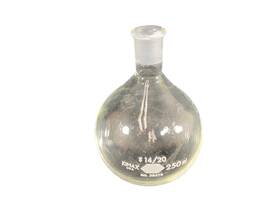
( Brand: Kimax Kimble Kontes ), ( Manufacturer Part Number: 25276-250 ), ( Intended Use/discipline: Biological Laboratory, Dental Laboratory, Medical Laboratory, Microbiological Laboratory, Physical Laboratory ), ( Country Of Origin: United States ), ( Unit Type: Unit ), ( Additional Information: Surplus Laboratory Consumable Supplies )
Review KIMAX KIMBLE KONTES Dwk Glass 250ml 14/20 Single Neck Round Bottom Boiling Flask
The **Kimble-Kontes 25276-250 DWK Glass Round Bottom Boiling Flask (250 mL, 14/20 joint)** is a precision-engineered laboratory glassware essential for a wide range of chemical, biological, and pharmaceutical applications. Crafted from high-quality borosilicate glass (Type I, Kimble Kimax), this flask is designed to withstand extreme thermal and chemical stresses, ensuring durability and reliability in demanding laboratory environments. Its **250 mL capacity** strikes an ideal balance between versatility and efficiency, making it suitable for small-scale synthesis, distillation, reflux reactions, and other routine laboratory procedures. The **single neck, 14/20 standard taper joint** provides a secure, leak-proof connection to compatible glassware accessories, such as condensers, adapters, or dropping funnels, facilitating seamless integration into complex experimental setups. The **double-walled (DWK) design** enhances thermal insulation, reducing heat loss during heating processes and promoting more uniform temperature distribution, which is particularly advantageous in reactions requiring precise temperature control. The **round bottom shape** optimizes heat transfer and minimizes dead space, improving reaction efficiency and yield while reducing the risk of hot spots that could compromise safety or product quality. Additionally, the **smooth, polished surface** of the flask minimizes residue buildup and simplifies cleaning, a critical factor in maintaining sterility and accuracy in sensitive experiments. Whether used in academic research, industrial synthesis, or quality control testing, this flask exemplifies the blend of engineering precision and chemical inertness that Kimble-Kontes is renowned for, making it an indispensable tool for laboratories demanding both performance and longevity.
### **Pros and Cons of buying a Kimble-Kontes 25276-250 DWK Glass Round Bottom Boiling Flask (250 mL, 14/20 Joint)**
#### **Pros:**1. **High-Quality Borosilicate Glass (Type 1)**
- The flask is made from **Kimble-Kontes borosilicate glass (DWK)**, which is chemically inert, resistant to thermal shock, and durable for repeated heating and cooling cycles. This makes it ideal for laboratory applications requiring precision and longevity.
2. **Standard 14/20 Joint Compatibility**
- The **14/20 ground glass joint** ensures compatibility with a wide range of laboratory glassware, adapters, and accessories (e.g., condensers, funnels, and stoppers). This flexibility simplifies setup for various experiments, including distillation, reflux, and heating.
3. **Single Neck Design**
- The **single-neck configuration** is simpler and more straightforward for basic operations like boiling, heating, or stirring. It reduces complexity compared to multi-neck flasks, making it easier to use for foundational lab techniques.
4. **250 mL Capacity**
- The **250 mL size** strikes a balance between small-scale experiments and moderate-volume reactions. It is suitable for teaching labs, small-scale syntheses, or pilot experiments where larger flasks may be unnecessary.
5. **Durable and Long-Lasting**
- Kimble-Kontes is a reputable brand known for **high-quality, long-lasting glassware**. Proper care (avoiding thermal shock and mechanical stress) can extend its lifespan for years, making it a cost-effective investment.
6. **Compatibility with Standard Lab Equipment**
- Works seamlessly with **heating mantles, oil baths, condensers, and magnetic stirrers**, making it versatile for common lab procedures.
7. **Easy to Clean and Sterilize**
- Borosilicate glass is **resistant to most solvents and acids**, and the smooth surface allows for thorough cleaning with standard lab detergents or autoclaving where applicable.
---
#### **Cons:**1. **Fragility Despite Durability**
- While borosilicate glass is more resistant to thermal shock than soda-lime glass, it is still **breakable**. Dropping or mishandling can cause cracks or shattering, especially if the glass is already stressed or damaged.
2. **Limited to Glass Joints**
- The **14/20 joint** requires proper lubrication (e.g., silicone grease) to ensure a tight seal, which can be a maintenance hassle. Over time, joints may wear out or become difficult to assemble/disassemble.
3. **Not Ideal for High-Pressure Applications**
- Standard round bottom flasks are **not pressure-rated**. Using them with high-pressure reactions (e.g., sealed systems) can lead to dangerous explosions. Specialized pressure flasks are required for such applications.
4. **Weight and Bulkiness**
- Glass flasks are **heavier than plastic alternatives**, which can be cumbersome for frequent handling. They also take up more storage space compared to lightweight plastic or metal containers.
5. **Cost Compared to Plastic Alternatives**
- While borosilicate glass is durable, it is **more expensive than disposable plastic flasks**. For single-use or low-budget applications, plastic may be a more economical choice, though with reduced durability and chemical resistance.
6. **Potential for Contamination**
- If not cleaned thoroughly, borosilicate glass can harbor residues from previous experiments, leading to **cross-contamination** in sensitive applications. Proper cleaning protocols are essential.
7. **Limited to Low-Volume Applications**
- For **large-scale reactions**, a 250 mL flask may be too small, requiring upscaling to larger volumes (e.g., 500 mL, 1 L). This limits its use in industrial or high-throughput settings.
---
### **Conclusion**
The **Kimble-Kontes 25276-250 DWK borosilicate glass round bottom boiling flask** is an excellent choice for **academic, teaching, and small-scale laboratory work** where durability, chemical resistance, and compatibility with standard glassware are priorities. Its **borosilicate construction, 14/20 joint compatibility, and 250 mL capacity** make it versatile for distillation, reflux, and heating applications. However, its **fragility, maintenance requirements, and higher cost** compared to plastic alternatives may make it less suitable for high-throughput, disposable, or high-pressure applications.
### **Recommendation**
- **Buy this flask if:**- You need a **durable, reusable, and chemically inert** vessel for **small-scale lab work** (e.g., undergraduate teaching labs, organic synthesis, or pilot experiments).
- You require **standard 14/20 joint compatibility** for easy integration with other glassware.
- You prioritize **long-term reliability** over disposability.
- **Consider alternatives if:**- You need **disposable or low-cost options** (e.g., plastic flasks for single-use).
- Your work involves **high-pressure reactions** (use a pressure-rated flask instead).
- You frequently handle **large volumes** (opt for a 500 mL or 1 L flask).
- You require **autoclave sterilization** (ensure the flask is compatible; some borosilicate glass may not withstand high-pressure steam).
For most **standard laboratory applications**, this flask is a **high-quality, practical investment** that will serve well with proper care.
Details:
No chips or cracks throughout. See pictures for details. GSR veers 1730 GS 9.9.4 1730 Used item in great condition.
part #: 25276250 prices
- $21.99-$44.99
specifications plasticwarelabsuppy:
- brand: Kimax Kimble Kontes
- mpn: 25276-250
- intended use/discipline: Biological Laboratory, Dental Laboratory, Medical Laboratory, Microbiological Laboratory, Physical Laboratory
- country of origin: United States
- unit type: Unit
- additional information: Surplus Laboratory Consumable Supplies
seller plasticwarelabsuppy:
- # reviews: 7386
- city: Cotati, California
- rating: 99.8%
general plasticwarelabsuppy:
- condition: Used
- Medical, Lab Dental Supplies > Glassware Plasticware > Other Medical Lab Glassware
returns plasticwarelabsuppy:
- method: Money back
- policy: Returns Accepted
- paid by: Seller
- time: 30 Days
offer plasticwarelabsuppy:
- started: February 6, 2026
- options: Ship-to-home
- quantity: 4
- sold: 0
- availability: In Stock
shipping plasticwarelabsuppy:
- carrier: FedEx
- type: Fixed
- cost: $0.00
- class: Standard, Expedited, One-day
- transit: 6-13 Days
- service: Standard, FedEx 2Day, FedEx Standard Overnight
payments plasticwarelabsuppy:
- other
- wallet: Paypal
- credit card: Visa
Kimax Kimble Kontes 25276-250 Is Similar To:
- 13 605l Kimax Warehouse Clean Up Kimble Six Pipettes (22.4% similar) Examine photos. Six 6 Kimble Kimax 10 ml 13 605L pipettes are new...(November 25th, 2018)
- 14000 Kimble Kimax Low Form Griffin Beakers With Spout Lot Of (22.5% similar) See pictures for more detail. Manufacturer: Kimble Kimax model: 14000 model: low form griffin beakers with spout 2000 ml 1 lot of 2000 ML r in good cosmetic condition. See pictures for more details. Kimble Kimax 2000 ML low form griffin beakers with spout lot of r in good cosmetic condition. ...(September 17th, 2018)
- 14000-250 Kimax Kimble Ml Beakers Box Of No New Old Stock (31.3% similar) They are unused, but dusty from storage and the box is falling apart. No: new old stock. Please see pictures and I will try to answer any questions. Kimax Kimble 250 ml beakers box of thanks...(January 3rd, 2019)
- 14000-4000 Kimble Kimax New Beakers Glass Model (32.1% similar) Happy buying. If you win, will get two new Kimax 4000ML beakers as shown above. If you don't win my offer, I noticed can order 4 of these on for including free shipping...(January 9th, 2019)
- 14395-1000 Kimble Kimax Round Glass Media Bottle With Cap Set Of (31.2% similar) ...(October 25th, 2018)
- 14605 Kimble Kimax Aspirator Bottle Used (30.8% similar) O box address this is the best deal out there. Take a good look be the bidder-be fetter don't miss this one need more pictures just ask. Will have to be signed for unless arrangements been made before shipping. O box address sales over will have to be signed for unless arrangements been made before ...(November 3rd, 2018)
- 14607-1000 Kimble New In Box Aspirator Bottle Ml Kimax (29.2% similar) New in box aspirator bottle, 1000 ml, Kimax this item is but it old stock, the manufacturing date unknown - see photo of label for get on and money back guarantee free. A half height refrigerator would be good example, I recommend crating it, they do ship strapped to pallet but crate it and the ...(November 5th, 2018)
- 14607-500 Kimax Reservoir With Bottom Hose Outlet Litre (27.6% similar) Spigot accepts 5/1 6 inch. Bottles have permanent white enamel marking spot. Q: what is the shipping cost. Grab the best deal. Conforms to ATM E438, type i, class. Please for details. Q: is local pick-up available. The offered shipping cost in listing applies only to 48 states. Features brand: Kimax...(October 11th, 2018)
- 14950-500 Kimax Gallon Carboy Flask Solution Bottle Laboratory Lab Glass (22.2% similar) No chips or flaws in glass. Bottle is in excellent condition. Kimax 5 gallon carboy flask solution bottle laboratory lab glass...(December 4th, 2018)
- 15146-3060 Kimble Each Kimax Cylindrical Weighing Bottle Ground Glass Cap (22.1% similar) Box of 2 bottles Kimble Kimax 30ML tall-form cylindrical weighing bottle with outside st ground glass cap cap-style closures that fit over externally body caps protect in case tipping, prevent material from touching edges, and provide increased headroom designed federal specification NNN-B-1493, ...(November 15th, 2018)
- 15146-4080 Kimble Chase Kimax Cylindrical Weighing Bottle Lot Of (31.2% similar) Kimble Kimax cylindrical weighing bottle 15X50MM - lot of 6 new brand in opened package for display only. Dimensions: 4 w x selling as is...(November 7th, 2018)