CORNING 3571BC Costar Flange Flat Bottom Microplate 384-WELL
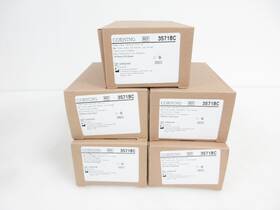
( Brand: Corning ), ( Manufacturer Part Number: 3571BC ), ( Part Type: Flange ), ( Unit Type: Unit ), ( Country Of Origin: United States ), ( Intended Use/discipline: Physical Laboratory )
Review CORNING Boxes Costar 384-well Low Flange Black Flat Bottom Microplate
The **Corning 3571BC Costar 384-Well Flange Flat Bottom Microplate** is a high-performance, precision-engineered laboratory consumable designed to meet the rigorous demands of modern biomedical research, drug discovery, and high-throughput screening applications. Crafted from **ultra-clear, low-autofluorescence polystyrene**, this microplate ensures optimal optical clarity, minimizing background interference during fluorescence, luminescence, or absorbance-based assays. The **flat-bottom design** provides superior cell adhesion and consistent assay performance, particularly in adhesion-dependent cell cultures or assays requiring precise liquid handling, such as ELISA, cell-based assays, or high-content screening. Each well features a **standard 384-well format (6 mm 8 mm)**, adhering to industry-wide compatibility with automated liquid handlers, plate readers, and robotic systems, ensuring seamless integration into existing workflows.
The **flange design** enhances stability during handling and stacking, reducing the risk of well deformation or cross-contamination, while the **rigid structure** minimizes warping, even under repeated use or exposure to extreme temperatures. Engineered for **low protein binding**, the plate surface promotes consistent assay reproducibility, reducing variability in binding kinetics and signal detection. Additionally, the **sterile, non-pyrogenic construction** ensures compatibility with sensitive biological samples, including cell cultures, nucleic acids, and proteins, while the **UV-transparent material** allows for reliable detection across a broad spectral range, from UV to visible light. Whether used in **high-content imaging, drug screening, or molecular biology**, this microplate delivers exceptional durability, chemical resistance, and assay performance, making it an indispensable tool for laboratories demanding precision and reliability in their experimental workflows.
**Pros and Cons of buying a Corning 3571BC Costar 384-Well Flange Flat Bottom Microplate**
### **Pros**
1. **High-Quality Material and Durability**
The Corning 3571BC is made from high-quality polystyrene, which is chemically resistant, inert, and suitable for a wide range of assays, including fluorescence, luminescence, and absorbance-based experiments. Its robust construction ensures longevity, reducing the need for frequent replacements.
2. **Optimal Flat Bottom Design**
The flat-bottom design enhances optical clarity and signal detection, making it ideal for high-sensitivity assays such as ELISA, cell-based assays, and high-throughput screening. This design minimizes edge effects and improves consistency across wells.
3. **Compatibility with Automated Systems**
The flange design allows for secure sealing with adhesive films or lids, making it compatible with automated liquid handling systems, plate readers, and robotic platforms. This is particularly advantageous for large-scale experiments or high-throughput screening workflows.
4. **Standardized Dimensions**
The 384-well format is widely used in biomedical research, pharmaceutical development, and drug discovery. Its standardized size ensures compatibility with most laboratory equipment, reducing the need for additional adapters or modifications.
5. **Cost-Effective for Large-Scale Use**
While the initial cost may be higher than some generic alternatives, the durability and performance justify the investment for laboratories conducting extensive experiments. Bulk purchases can further reduce per-unit costs.
6. **Low Non-Specific Binding**
The surface properties of the Corning 3571BC minimize non-specific binding, improving assay sensitivity and reducing background noise. This is critical for experiments requiring precise detection of low-abundance targets.
7. **Wide Range of Applications**
The plate is versatile and can be used for various applications, including cell culture, protein assays, DNA/RNA quantification, and compound screening. Its compatibility with multiple detection methods expands its utility in diverse research settings.
---
### **Cons**
1. **Higher Upfront Cost**
Compared to generic or lower-quality microplates, the Corning 3571BC is more expensive. Laboratories with tight budgets may find this a significant drawback, especially if they do not require the highest performance.
2. **Limited Flexibility for Specialized Assays**
While the plate is highly versatile, it may not be optimized for highly specialized or niche applications that require unique surface coatings or materials. In such cases, alternative plates with specific treatments (e.g., low-binding, high-binding, or coated surfaces) might be necessary.
3. **Potential for Static Electricity**
Polystyrene plates can sometimes generate static electricity, which may interfere with liquid handling or sample distribution. This can be mitigated by using anti-static mats or careful handling techniques.
4. **Environmental Considerations**
Disposal of polystyrene plates can be a concern in environmentally conscious laboratories. While they are recyclable, not all facilities have access to polystyrene recycling programs, which may pose challenges for large-scale users.
5. **Compatibility with Certain Reagents**
While generally resistant to most reagents, extreme conditions (e.g., highly acidic or alkaline solutions, organic solvents, or high temperatures) may degrade the plate over time. Users must ensure compatibility with their specific experimental conditions.
6. **Potential for Well-to-Well Variability**
Although minimal, slight variations in well depth or surface properties can occur between plates or even within a single plate. This may require occasional quality checks, particularly in high-precision experiments.
---
### **Conclusion**
The Corning 3571BC Costar 384-well flange flat bottom microplate is a high-performance, reliable choice for laboratories engaged in demanding assays, high-throughput screening, or routine experiments requiring precision and consistency. Its advantages in optical clarity, durability, and compatibility with automated systems outweigh its drawbacks for most research applications. However, the higher cost and potential limitations in specialized or extreme conditions may make it less ideal for budget-conscious or highly specialized workflows.
### **Recommendation**
**Purchase the Corning 3571BC if:**- Your laboratory conducts high-sensitivity assays, cell-based experiments, or high-throughput screening.
- You require compatibility with automated liquid handling and plate readers.
- You prioritize long-term durability and minimal non-specific binding.
- Budget constraints are not a critical factor, and the plate s performance justifies the investment.
**Consider alternatives if:**- Your experiments involve extreme reagents or conditions that may degrade polystyrene.
- You require specialized surface treatments not offered by this plate.
- Cost is a major limiting factor, and you can find equally reliable generic options at a lower price.
- Your workflow involves highly specialized assays where alternative plate formats (e.g., 96-well or coated plates) are more suitable.
For most standard and high-demand applications, the Corning 3571BC remains a top-tier choice due to its proven performance and widespread compatibility.
Details:
Shipping Buyer pays for all shipping costs. Warranty This item is guaranteed to be as described. Power cords and power adapters are never included unless specifically mentioned. 5 BOXES CORNING COSTAR 3571BC 384-WELL LOW FLANGE BLACK FLAT BOTTOM MICROPLATE: This lot is for one Lot Five Boxes Corning Costar EXP 2025-08-25.
384-well Low Flange Black Flat Bottom Polystyrene TC-treated Microplate, with Generic Bar codes, 10 per Bag, Lid, Sterile. Orders are shipped to the cardholders billing address.
part #: 3571bc prices
- $52.49-$139.99
specifications plasticwarelabsuppy:
- brand: Corning
- mpn: 3571bc
- part type: Flange
- unit type: Unit
- country of origin: United States
- intended use/discipline: Physical Laboratory
returns plasticwarelabsuppy:
- policy: No Returns
offer plasticwarelabsuppy:
- sold: 0
- started: May 9, 2026
- quantity: 4
- best offers: True
- availability: In Stock
- options: Ship-to-home
payments plasticwarelabsuppy:
- wallet: Paypal
- credit card: Mastercard
- other
seller plasticwarelabsuppy:
- rating: 100.0%
- # reviews: 8529
- city: Las Vegas, Nevada
shipping plasticwarelabsuppy:
- transit: 4-10 Days
- carrier: USPS, UPS
- class: Standard
- service: USPS Ground Advantage, UPS Ground
- cost: $17.50
- type: Calculated
general plasticwarelabsuppy:
- condition: New Open box
- Medical, Lab Dental Supplies > Glassware Plasticware > Other Medical Lab Glassware
Corning 3571BC Is Similar To:
- 1000-400 Corning Pyrex Glass Graduated Low Form Griffin Beaker (34.3% similar) 400ML low form Pyrex griffin beaker with spout, double scale, graduated convenient graduated metric scale for estimating content graduation range: 25-325ML graduation interval: 25ML height : 110MM approx outer diameter: 77MM extra large marking spot...(November 27th, 2018)
- 1686 Corning New Pyrex Red Low Actinic Weighing Bottle (37.9% similar) Shipping in USA is this is for a new Pyrex red low anionic 30ML weighing bottle it standard taper joint. Cap slides over body...(June 24th, 2019)
- 25820 Corning Lot Of Cell Well Tissue Culture Plate With Lid (36.2% similar) Lot of 48 Corning 24 cell well tissue culture plate with lid new sealed...(May 26th, 2018)
- 2797 Corning Costar New Lot (38.1% similar) Standard shipping prices are only good for the lower 48 states. Minimum handling charge is 75 onto a standard pallet and increases for custom pallet's. If you do receive the package, submit clear images of packaging box and damaged item from multiple angles. Do not discard the packaging. All parts, ...(April 18th, 2017)
- 3151 Nalgene Qty 5 Corning Costar (25.2% similar) It has a 162CM2 available growth area, and been Tc-treated for optimal cell attachment. Cap style: vented. Maximum working volume: 175ML. Printed with lot numbers for ease in traceability, it is 100 integrity tested. Review the pictures for included elements and condition of item. Flask shape: ...(March 10th, 2017)
- 3213 Corning Costar 2ml Non-sterile (37.2% similar) Corning costar 2ML non-sterile graduated micro centrifuge tubes, 3213...(May 24th, 2017)
- 3335 Corning Costar Qty 30 (32.7% similar) Review the pictures for included elements and condition of item...(June 2nd, 2017)
- 3338 Corning 25 48 Well (27.7% similar) Review the pictures for included elements and condition of item...(January 13th, 2018)
- 3340 Corning Assay Plate 96-well W (32.1% similar) All of our listing items was base on the pictures. Please accept our apology for any errors or mistakes on the if pictures is unclear, you can request us more better and feel free to contact questions. All return shipping charges must be prepaid by the customer. Sometime error would happen but ...(February 22nd, 2017)
- 3344 Corning Polypropylene Volume Clear Microplate Case Of (41.2% similar) Corning 3344 polypropylene v-bottom 96 well expanded volume clear microplate, without lid case of excellent condition. Unused, ready to use...(July 8th, 2018)
- 3355 Corning Costar Case 100 (34% similar) Review the pictures for included elements and condition of item...(August 11th, 2017)