PYREX 7570N-24 Stopper Hollow Joint 24/40
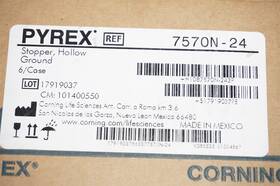
( Brand: Pyrex ), ( Manufacturer Part Number: 7570N-24 ), ( Part Type: Stopper Joint Case )
Review PYREX Stopper Hollow Ground Case Joint Size 24/40
The **Pyrex 7570N-24 Stopper with Hollow Joint (24/40)** is a precision-engineered laboratory glassware component designed for high-performance chemical, analytical, and scientific applications where reliability, durability, and compatibility with a wide range of solvents are essential. Crafted from **Pyrex 7570 borosilicate glass**, this stopper exhibits exceptional thermal and chemical resistance, making it ideal for use in demanding environments such as distillation, extraction, chromatography, and other procedures requiring airtight sealing or inert atmospheres. The **24/40 standard taper joint** ensures a secure, leak-proof fit with compatible glassware, including flasks, condensers, and reaction vessels, while the **hollow design** allows for efficient gas flow or venting, reducing pressure buildup and minimizing the risk of contamination. Engineered to withstand repeated sterilization cycles, thermal shock, and exposure to aggressive chemicals including acids, bases, and organic solvents the stopper maintains its structural integrity and clarity over prolonged use. Its smooth, polished surface facilitates easy cleaning and reduces the likelihood of residue buildup, while the durable construction ensures longevity even under rigorous laboratory conditions. Whether used in academic research, industrial synthesis, or pharmaceutical development, this stopper exemplifies Pyrex s commitment to quality and performance, providing a dependable solution for applications where precision and safety are paramount.
**Pros and Cons of buying a Pyrex 7570N-24 Stopper Hollow Joint (24/40)**
The Pyrex 7570N-24 stopper hollow joint is a classic piece of laboratory glassware, often used in chemistry for distillation, extraction, and other procedures requiring a joint connection. Below is a detailed breakdown of its advantages and disadvantages.
### **Pros**
1. **Durability and Longevity**
The Pyrex brand is known for its borosilicate glass composition, which is highly resistant to thermal shock and chemical corrosion. This makes the joint durable and capable of withstanding repeated heating and cooling cycles without cracking or degrading over time. Many Pyrex glassware pieces last decades with proper care.
2. **Standardized Joint Size (24/40)**
The 24/40 joint is a widely accepted standard in laboratory glassware, ensuring compatibility with most other glass apparatuses, adapters, and accessories. This makes it easy to integrate into existing setups or modify experiments without needing specialized fittings.
3. **Chemical Resistance**
Borosilicate glass (like Pyrex) is inert to most acids, bases, and organic solvents, making the joint suitable for a wide range of chemical reactions. It does not leach contaminants into samples, which is critical for analytical work.
4. **Heat Resistance**
The material can withstand high temperatures, often up to 500 C or more, depending on the specific application. This is useful for distillation, reflux, or other high-temperature processes.
5. **Versatility in Applications**
The stopper hollow joint can be used in various setups, such as:- **Distillation setups** (e.g., as a receiver or condenser adapter).
- **Extraction apparatuses** (e.g., Soxhlet extractors).
- **Reaction vessels** (e.g., as a stopper for flasks).
Its hollow design allows for the passage of liquids or gases, making it functional in more complex setups.
6. **Cost-Effective for Long-Term Use**
While the initial cost may be higher than some plastic alternatives, Pyrex glassware is a one-time investment that pays off over time due to its durability. Replacing a broken plastic joint or adapter repeatedly can become more expensive in the long run.
7. **Easy to Clean and Sterilize**
Glass is non-porous and can be thoroughly cleaned with solvents, detergents, or even harsh acids (with caution). It can also be sterilized by autoclaving or baking, which is not possible with many plastic components.
8. **Aesthetic and Professional Appearance**
Pyrex glassware has a clean, transparent look that is often preferred in academic or industrial labs for its professional appearance. It also allows for visual monitoring of reactions or processes.
9. **Compatibility with Vacuum Systems**
The 24/40 joint can be used in vacuum applications, provided the setup is properly sealed. This makes it useful for processes like rotary evaporation or vacuum filtration.
10. **Ease of Repair**
Minor cracks or scratches can sometimes be repaired with epoxy or specialized glass repair kits, though this is not always reliable for critical applications. Major breaks can often be replaced or repaired by glassblowers.
---
### **Cons**
1. **Fragility Compared to Plastic**
While borosilicate glass is more durable than soda-lime glass, it is still brittle and can shatter if dropped or subjected to sudden impacts. This makes it less ideal for rough handling or fieldwork where protection (e.g., from a case) is not possible.
2. **Weight**
Glass is heavier than plastic alternatives, which can make setups more cumbersome to assemble, disassemble, or transport. This may be a consideration in large-scale or mobile laboratories.
3. **Potential for Leaks**
Over time, the ground glass joints can become worn or develop scratches, leading to leaks if not properly lubricated with high-vacuum grease or stopcock grease. This requires regular maintenance to ensure a tight seal.
4. **Limited Flexibility in Design**
Unlike plastic or flexible tubing, glass joints are rigid and cannot be bent or reshaped. This limits their use in applications requiring flexibility, such as certain types of flow systems or custom setups.
5. **Maintenance Requirements**
Ground glass joints must be cleaned and lubricated regularly to prevent sticking or leaks. Improper cleaning (e.g., using abrasive materials) can damage the joint surfaces, reducing their lifespan.
6. **Cost of Replacement Parts**
While the joint itself is durable, replacement parts like stoppers, adapters, or new joints can be expensive, especially if they are no longer in production. Some older Pyrex parts may require sourcing from specialty suppliers.
7. **Not Suitable for Extreme Conditions**
While borosilicate glass is heat-resistant, it is not indestructible. Prolonged exposure to very high temperatures (e.g., above 600 C) or rapid thermal changes can still cause stress fractures. Additionally, it is not suitable for use with highly corrosive substances like hydrofluoric acid, which attacks glass.
8. **Environmental Concerns**
Glass is not biodegradable, and disposal can be more complex than with plastic. While recyclable, it may require specialized recycling facilities, especially if contaminated with chemicals.
9. **Learning Curve for Assembly**
Properly assembling glass joints requires practice to ensure a tight, leak-free seal. Beginners may struggle with lubrication techniques or alignment, leading to inefficiencies or accidents.
10. **Limited Availability of New Stock**
Some Pyrex products, including older models, may be discontinued. While they remain functional for decades, sourcing replacements for broken or lost pieces can be difficult, particularly for niche sizes like the 7570N-24.
---
### **Conclusion**
The Pyrex 7570N-24 stopper hollow joint is a high-quality, versatile piece of laboratory glassware that excels in durability, chemical resistance, and compatibility with standard laboratory setups. Its borosilicate construction ensures reliability in demanding applications, making it a staple in academic, industrial, and research laboratories. The 24/40 joint size further enhances its utility by ensuring broad compatibility with other glassware.
However, its fragility, weight, and maintenance requirements present practical challenges, particularly in environments where rough handling or frequent assembly/disassembly is common. The need for regular lubrication and cleaning can also be seen as a minor inconvenience compared to the long-term benefits.
For most traditional laboratory applications such as distillation, extraction, or reflux where durability and chemical resistance are prioritized, the Pyrex 7570N-24 is an excellent choice. It is particularly well-suited for:
- **Chemistry labs** performing routine organic or inorganic synthesis.
- **Academic settings** where equipment must last for years.
- **Applications requiring high-temperature or chemical resistance**.
In contrast, if the application involves frequent handling, extreme flexibility, or cost-sensitive disposable use, plastic alternatives (e.g., polycarbonate or PTFE joints) might be more practical, despite their shorter lifespan.
---
### **Recommendation**
**Buy the Pyrex 7570N-24 stopper hollow joint if:**- You are working in a laboratory setting where durability, chemical resistance, and compatibility with standard glassware are critical.
- You plan to use it for long-term applications such as distillation, extraction, or reflux.
- You are willing to invest in proper maintenance (e.g., lubrication, cleaning) to ensure its longevity.
- You value the standardized 24/40 joint for easy integration with other glass apparatuses.
**Avoid or consider alternatives if:**- Your work involves frequent handling or rough conditions where fragility could be a concern.
- You are operating on a tight budget and cannot afford the initial cost or potential replacement parts.
- Your applications require flexibility or disposable components (e.g., single-use setups).
- You are working with highly corrosive substances (e.g., hydrofluoric acid) that may damage the glass over time.
**Final Verdict:** For most traditional laboratory uses, the Pyrex 7570N-24 is a worthwhile investment. Its reliability and versatility outweigh the minor drawbacks, especially for those who prioritize quality and longevity in their equipment. If you are unsure, test it in a low-stakes application first to assess its suitability for your specific needs.
Details:
The flat top allows the stopper to stand on its head, which frees users hand and minimizes potential contamination. These hollow stoppers are light in weight, yet very strong to reduce chipping and breakage, thus minimizing replacement costs. 1 was available at listing time. Pyrex 7570N-24, Stopper Hollow Ground 6 / Case, Joint Size 24/40, This is a 24/40.
Cases count against me even if they are resolved. Grooves in the sides help prevent slippage. A barrel-shaped head means it is easy to clean and even easier rotate in or out. Corning sells these for $239.65 a case of 6.
part #: 7570n24 prices
- $9.99-$50.00
specifications plasticwarelabsuppy:
- brand: Pyrex
- mpn: 7570n-24
- part type: Stopper Joint Case
returns plasticwarelabsuppy:
- paid by: Buyer
- time: 30 Days
- policy: Returns Accepted
- method: Money back
general plasticwarelabsuppy:
- condition: New Open box
- Medical, Lab Dental Supplies > Glassware Plasticware > Other Medical Lab Glassware
payments plasticwarelabsuppy:
- wallet: Paypal
- credit card: Mastercard
- other
shipping plasticwarelabsuppy:
- class: Expedited, One-day
- cost: $13.95
- service: USPS Priority Mail Flat Rate Envelope, UPS Next Day Air
- transit: 4-9 Days
- carrier: USPS, UPS
- type: Calculated
seller plasticwarelabsuppy:
- rating: 100.0%
- # reviews: 10898
- city: Natick, Massachusetts
offer plasticwarelabsuppy:
- availability: In Stock
- options: Ship-to-home
- sold: 0
- best offers: True
- quantity: 1
- started: April 11, 2026
Pyrex 7570N-24 Is Similar To:
- 1760-250 Pyrex Gas Washing Bottle Plain Stem New Condition Joint (36.5% similar) Pyrex gas washing bottle. Never used, not in original packaging. 2 units available. 250ML bottle with plain stem and joint. Shipped with USPS priority mail...(May 28th, 2019)
- 2400-300 Corning Pyrex Glass Liebig Condenser Drip Tip Standard Taper Joint (32.1% similar) 10MM hose connectors. Thorough cleaning and sterilization are recommended before use. Great condition. I found this in an estate sale so have no idea what has been around it. 450MM total height 300MM jacketed section. Used glassware will show signs of wear sometimes including residue, light ...(December 11th, 2018)
- 2640 Pyrex Corning Friedrichs Condenser Drip Tip With Lower Joint (29.9% similar) Its like new never been used...(November 23rd, 2018)
- 431473 Corning Pyrex Case 500 (26.4% similar) This leak-proof design comes with a revolutionary plug feature that virtually eliminates all seepage when used under recommended conditions. Review the pictures for included elements and condition of item. This orange centrist cap for 50ML centrifuge tubes has a easy-on easy-off flat top and offers ...(September 1st, 2017)
- 4980250 Pyrex Vtg Laboratory Glass Flask Case Of Corning Works (37.1% similar) In original box. Twelve flask VG Pyrex corning ware 125ML laboratory glassware. Box is a little bit tattered on top otherwise all original flask in...(October 31st, 2018)
- 5100 Pyrex Stopper Lab Graduated Wide Mouth Erlenmeyer Flask (44.3% similar) Minimum handling charge is 75 onto a standard pallet and increases for custom pallet's. 13 2000 ML lab graduated wide mouth Erlenmeyer flask model: 5100 no noticeable damage on unit scratches, unknown residue, and scuffs dimensions l x w h: 6/1 1 as a large liquidator for many vendors, our rating ...(November 1st, 2018)
- 5320-1l Corning Pyrex Glass Heavy Duty Wall Conical Filter Flask Case (27.5% similar) Part: 5320-1L prices...(September 14th, 2018)
- 5615b22 Pyrex Gas Washing Bottle Joint Tall New (33% similar) Made in England. One beautiful piece of lab equipment sent fast and packed to perfection...(October 20th, 2018)
- 5635-200 Corning Pyrex Borosilicate Glass Class Heavy Duty Capacity Case Of (24.8% similar) The graduation line is sharp and permanent. For replacement stoppers, see no. Corning Pyrex brisket glass class a heavy duty ex access wide mouth volumetric flask with standard taper stopper, 200ML capacity case of 6 these flasks are calibrated to tolerances and designed for micro chemical work ...(November 3rd, 2018)
- 6340-4l Pyrex Globe Style Separatory Funnel Pennyhead Stopper Exc Cond (30.3% similar) ...(March 9th, 2019)
- 6402-2l Pyrex Seperatory Separatory Funnel Stopper Teflon Stopcock (32.8% similar) You are buying a 2000 ML Pyrex separator funnel. If you are not happy, we happy. Condition: this item is used. Use shipping calculator for expedited options. Could use a cleaning...(November 29th, 2018)