ACE GLASS 8064-13 Stirrer Bearing Shaft Ptfe Blade Set 24/40
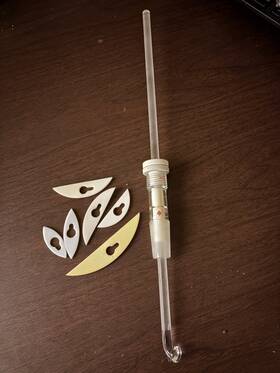
( Brand: Ace Glass ), ( Manufacturer Part Number: 8064-13 ), ( Part Type: Bearing Stirrer Shaft Blade ), ( Country Of Origin: United States ), ( Intended Use/discipline: Chemistry/biochemistry/biology Laboratory )
Review ACE GLASS Stirrer Assembly 24/40 Bearing Shaft And Ptfe Blade Set
The **Ace Glass 8064-13 Stirrer with 24/40 Bearing Shaft and PTFE Blade Set** is a precision-engineered laboratory accessory designed to deliver reliable and efficient mixing performance in a wide range of chemical, biological, and pharmaceutical applications. This high-quality stirrer features a robust **24/40 standard taper joint**, ensuring a secure and leak-proof connection to compatible glassware, including flasks, beakers, and reaction vessels, while maintaining optimal sterility and ease of assembly. The **bearing shaft** is meticulously crafted to provide smooth, low-friction operation, reducing wear and extending the lifespan of both the stirrer and the motor assembly, making it ideal for prolonged stirring sessions without overheating or mechanical failure.
The **PTFE (polytetrafluoroethylene) blade set** is a standout feature, offering exceptional chemical resistance and non-reactivity with virtually all solvents, acids, and bases, including strong oxidizing agents. PTFE s inert properties prevent contamination of sensitive samples, ensuring accurate and reproducible results in demanding experiments such as polymerization, crystallization, or sensitive biochemical assays. The blades are designed with a sleek, aerodynamic profile to maximize turbulence and mixing efficiency, promoting uniform dispersion of liquids and solids while minimizing splashing. Their smooth, non-stick surface also facilitates easy cleaning and maintenance, a critical consideration in laboratories where sterility and precision are paramount.
Constructed from durable materials, the Ace Glass stirrer is built to withstand the rigors of heavy-duty laboratory use, including high-speed stirring and exposure to corrosive environments. The **24/40 joint** adheres to industry standards, ensuring compatibility with a vast array of glassware and accessories, while the PTFE blade set s compatibility with a wide temperature range from cryogenic to high-heat applications makes it versatile for both low-temperature and elevated-temperature processes. Whether used in routine synthesis, large-scale production, or delicate analytical procedures, this stirrer delivers consistent performance with minimal maintenance, making it a trusted tool for researchers, chemists, and technicians seeking reliability and precision in their mixing operations.
**Pros and Cons of buying a Ace Glass 8064-13 Stirrer (24/40 Bearing Shaft, PTFE Blade Set)**
### **Pros**
1. **High-Quality Construction** The stirrer features a durable stainless steel shaft with a 24/40 joint, ensuring compatibility with standard laboratory glassware. The PTFE (polytetrafluoroethylene) blade is chemically resistant, making it suitable for a wide range of solvents and corrosive substances.
2. **Precision Engineering** The bearing assembly is designed to provide smooth, low-friction operation, reducing wear and extending the lifespan of the stirrer. This is particularly useful for long-term or high-intensity mixing applications.
3. **Versatility** The PTFE blade is non-reactive, meaning it won t contaminate sensitive samples, making it ideal for pharmaceutical, biochemical, and analytical chemistry applications. The 24/40 joint ensures a secure and leak-proof connection to flasks and other glassware.
4. **Compatibility with Standard Lab Equipment** The 24/40 joint is a widely accepted laboratory standard, meaning this stirrer will work seamlessly with most magnetic stirrers, hot plates, and other mixing devices.
5. **Easy to Clean and Maintain** PTFE is non-porous and resistant to most chemicals, making it easy to clean and sterilize. The smooth surface also prevents bacterial buildup, which is beneficial for sterile applications.
6. **Cost-Effective for Laboratory Use** While not the cheapest option, the durability and performance of this stirrer make it a cost-effective investment for laboratories that require reliable stirring over extended periods.
7. **Suitable for High-Temperature Applications** PTFE has a high thermal stability, allowing the stirrer to be used in applications involving moderate to high temperatures without degradation.
---
### **Cons**
1. **Limited to Glassware with 24/40 Joints** If your laboratory primarily uses non-standard glassware (e.g., 19/26 joints or plastic containers), this stirrer may not be compatible, requiring additional adapters or alternative equipment.
2. **Potential for PTFE Wear Over Time** While PTFE is durable, prolonged use with abrasive materials or high-speed stirring could lead to gradual wear of the blade, necessitating eventual replacement.
3. **Not Ideal for Very High-Speed Stirring** The bearing assembly may not be optimized for extremely high-speed applications (e.g., above 1,500 RPM), where specialized high-speed stirrers with ceramic bearings might be more appropriate.
4. **Weight and Bulk** The stainless steel shaft and bearing assembly add weight to the stirrer, which could be less convenient for manual handling compared to lighter alternatives.
5. **Potential for Contamination Risks with Improper Use** Although PTFE is non-reactive, improper cleaning or exposure to certain aggressive chemicals (e.g., highly fluorinated compounds) could still pose risks, though this is rare with proper usage.
6. **Higher Initial Cost Compared to Basic Stirrers** For basic laboratory tasks, simpler stirrers with plastic or lower-grade blades may suffice at a lower cost. This stirrer is best justified for specialized or high-demand applications.
7. **Limited Availability of Replacement Parts** While PTFE blades and bearings are durable, if a component fails, finding exact replacements may be more challenging than with more widely available stirrers.
---
### **Conclusion**
The Ace Glass 8064-13 stirrer is a high-quality, reliable choice for laboratories requiring precise and chemically inert stirring. Its PTFE blade and stainless steel construction make it ideal for applications involving sensitive samples, corrosive chemicals, or high-temperature conditions. The 24/40 joint ensures broad compatibility with standard laboratory glassware, and the bearing assembly provides smooth, long-lasting performance.
However, its suitability depends on your specific needs. If your workflow involves only basic stirring or non-standard glassware, a more affordable or simpler stirrer might be sufficient. On the other hand, if you require a durable, chemically resistant, and versatile stirring solution for demanding applications, this stirrer is a strong recommendation.
### **Recommendation**
**Buy this stirrer if:**- You work in a laboratory setting where chemical resistance and precision are critical (e.g., pharmaceutical, biochemical, or analytical chemistry).
- Your glassware uses the 24/40 joint standard.
- You need a long-term, low-maintenance stirring solution for moderate to high-intensity applications.
- You prioritize compatibility with a wide range of solvents and temperatures.
**Avoid or consider alternatives if:**- Your laboratory primarily uses non-standard glassware (e.g., 19/26 joints or plastic containers).
- You require extremely high-speed stirring (above 1,500 RPM), in which case a high-speed ceramic-bearing stirrer may be better.
- Budget constraints make a simpler, lower-cost stirrer more practical for your needs.
- You frequently handle highly abrasive or particulate-heavy samples that could wear down the PTFE blade quickly.
Details:
I found an assortment of blades, several which have yellowed over the years, but all entirely functional. This is a vintage, 224/40 joint Glass overhead stirrer bearing and assembly. It is in pristine condition.
part #: 806413 price
- $205.00
specifications plasticwarelabsuppy:
- brand: Ace Glass
- mpn: 8064-13
- part type: Bearing Stirrer Shaft Blade
- country of origin: United States
- intended use/discipline: Chemistry/biochemistry/biology Laboratory
payments plasticwarelabsuppy:
- other
- credit card: Visa
- wallet: Google-pay
seller plasticwarelabsuppy:
- rating: 100.0%
- city: Rush, New York
- # reviews: 454
general plasticwarelabsuppy:
- condition: Seller refurbished
- Medical, Lab Dental Supplies > Glassware Plasticware > Other Medical Lab Glassware
shipping plasticwarelabsuppy:
- transit: 6-13 Days
- type: Calculated
- cost: $0.00
- class: Standard
- carrier: USPS
- service: USPS Ground Advantage
offer plasticwarelabsuppy:
- best offers: True
- started: May 28, 2026
- sold: 0
- options: Ship-to-home
- availability: In Stock
- quantity: 1
returns plasticwarelabsuppy:
- policy: No Returns
Ace Glass 8064-13 Is Similar To:
- 1200ml Ace Glass Instatherm Low Form Oil Bath With Cord (37.6% similar) Review the pictures for included elements and condition of item. See pictures for more details. Max volts :120. This is for one used 1200ML Ace Glass einsteinium oil bath. To make sure you are getting an accurate quote via the shipping calculator, your zip code is default when calculating cost for ...(October 25th, 2018)
- 19-38 Ace Glass Incorporated Lab (29.1% similar) Please see pictures and I will try to answer any questions. It is used and needs to be cleaned up. I honestly don't know exactly what it is so how to better describe. Ace Glass I got it from a university offer with bunch of other stuff...(March 30th, 2019)
- 3840-lco Pyrex Bulb Ace Glass Laboratory Chemistry Glassware (27.5% similar) I don't know what they are used for, but assume have been used, because were with a group of these items, some which clearly. The pictures you see are of actual item. You are buying on a pair of items. The Ace Glass item has a chip on very bottom. So, I assume they may need to be cleaned for your ...(June 30th, 2019)
- 40-35 Ace Glass Laboratory Total Length Approx Not Sure Porosity Read (34% similar) Not sure what its proper name is. Ace Glass laboratory total length approx 15 not sure: porosity maybe - read I picked this up from a local colleges liquidation sale over 10 years ago. It does not come with its original box but is new old stock. I saw some that looked similar called porosity. ...(February 4th, 2019)
- 513654 Ace Glass Claisen Distilling Adapter Thread St (42.7% similar) ...(January 14th, 2019)
- 5295-16 Ace Glass Outlet Stopcock Flask Adapter With Straight Tip Size (40.5% similar) Warranty this item is guaranteed to be as described. Power cords and adapters are never included unless specifically mentioned. Good luck buying. It comes with a 14 day guarantee against being DOA from receipt. Always here to help this unit will arrive in the condition shown. On the ask a question ...(March 29th, 2019)
- 5837-53 Ace Glass Ptfe Thread Tip Adapter (31.9% similar) Ace Glass ptfe lure-Loki 50 thread tip adapter with o-ring used lightly. Selling as is...(January 23rd, 2019)
- 5846-47 Pyrex Ace Glass Teflon Ptfe Back Seal Plug For Pressure (34% similar) Used in excellent condition...(March 3rd, 2019)
- 5848-58 Ace Glass 6 Polyethylene (29.1% similar) 6 per package. Selling as is. 6 Ace Glass polyethylene filter discs unknown porosity new qty...(January 21st, 2018)
- 5964-12 Ace Glass Dewar Type Condenser Id Jacket Joint Od Connect (26.6% similar) In great used condition. Very small chip on bottom joint. Used Glassware will show signs of wear sometimes including light scratches, discoloration, stickers tape, or exterior markings. Thorough cleaning and sterilization are recommended before use...(November 12th, 2018)
- 6563 Ace Glass Distillation High Boiling Still (37.1% similar) Note: if pot bleed is desired, a two neck flask can be used. Thermometer joint is for 9551, 25MM immersion. Useful for separating higher boiling liquids that require a short pot-to-column distance to prevent excessive condensation...(January 2nd, 2019)