KIMBLE 885302-0040 Tissue Grind Pestle
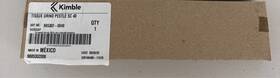
( Brand: Kimble ), ( Manufacturer Part Number: 885302-0040 ), ( Unit Type: Unit )
Review KIMBLE Tissue Grind Pestle Sc 40
The **Kimble Kimblex 885302-0040 Tissue Grind Pestle** is a precision-engineered laboratory tool designed for efficient and consistent tissue homogenization, making it an indispensable asset in biological research, molecular biology, and cell culture applications. Crafted from high-quality borosilicate glass, this pestle features a smooth, tapered design optimized to minimize sample loss and maximize extraction efficiency while reducing the risk of contamination a critical consideration in sterile environments. The robust construction ensures durability, allowing for repeated use without degradation, even when processing tough or fibrous tissues like muscle, plant matter, or insect samples. Its tight-fitting, ground-glass seal with the corresponding mortar creates an airtight seal, enabling effective mechanical disruption of cells and tissues through manual grinding, which is essential for releasing intracellular components for downstream applications such as DNA/RNA extraction, protein isolation, or metabolic studies. The pestle s ergonomic handle provides a comfortable grip, reducing user fatigue during prolonged use, while its uniform diameter ensures consistent grinding motion, promoting even sample processing. Ideal for use with the matching Kimblex mortar, this pestle is compatible with a wide range of tissue types, from delicate plant tissues to dense animal tissues, making it a versatile choice for laboratories requiring reliable, glassware-based homogenization. Whether used in academic research, pharmaceutical development, or clinical diagnostics, the Kimble 885302-0040 delivers precision and reliability, reinforcing its status as a cornerstone tool for any laboratory focused on tissue processing.
### **Pros and Cons of buying a Kimble 885302-0040 Tissue Grind Pestle (40mm)**
#### **Pros:**1. **Durability and Quality** Made from high-quality borosilicate glass, this pestle is resistant to thermal shock and chemical corrosion, making it suitable for long-term laboratory use.
2. **Precision Grinding** The 40mm size is ideal for homogenizing soft tissues, cells, or small biological samples with minimal loss of material.
3. **Compatibility** Designed to fit standard 40mm tissue homogenizers (e.g., Kimble s own homogenizers or similar models), ensuring a secure and efficient grinding action.
4. **Easy Cleaning** Glass surfaces are non-porous, reducing the risk of contamination and making them easier to sterilize compared to plastic or metal alternatives.
5. **Cost-Effective for Bulk Use** While individual units may seem expensive, the durability justifies the investment in high-throughput labs where frequent replacements would be costly.
6. **Chemical Resistance** Resists degradation from common laboratory solvents, acids, and bases, extending its lifespan in harsh environments.
7. **Consistent Performance** The uniform grinding surface ensures reproducible results, which is critical in research and diagnostic settings.
#### **Cons:**1. **Fragility Compared to Metal** While borosilicate glass is durable, it can still shatter if dropped or subjected to extreme impacts, unlike metal pestles.
2. **Higher Initial Cost** More expensive than plastic or disposable alternatives, which may be a barrier for small labs or budget-conscious users.
3. **Weight** The glass pestle is heavier than plastic options, which can lead to fatigue during prolonged use, especially in manual homogenization.
4. **Limited Reusability in Some Cases** If used with highly abrasive or fibrous samples, the grinding surface may wear over time, potentially affecting efficiency.
5. **Maintenance Requirements** Requires thorough cleaning and occasional inspection for cracks or damage, unlike disposable options that can be discarded after use.
6. **Not Ideal for Hard Samples** While effective for soft tissues, it may struggle with harder biological materials (e.g., bones or plant stems) compared to metal pestles.
7. **Potential for Contamination** If not properly cleaned, glass surfaces can harbor residues, though this is less of an issue than with porous materials.
---
### **Conclusion**
The **Kimble 885302-0040 Tissue Grind Pestle** is a high-quality, reliable tool for laboratories requiring precise and durable tissue homogenization. Its borosilicate glass construction ensures chemical resistance, longevity, and consistent performance, making it a strong choice for research, clinical diagnostics, and routine laboratory work. However, its higher cost, weight, and fragility compared to alternatives may not suit every application or budget.
For labs prioritizing **durability, chemical resistance, and reproducibility**, this pestle is an excellent investment. For **budget-conscious users or those handling very hard samples**, a metal or disposable alternative might be more practical.
### **Recommendation:** **Buy this pestle if:**- You work in a lab with frequent tissue homogenization needs.
- You require chemical resistance and long-term durability.
- Your budget allows for a higher upfront cost in exchange for reliability.
**Consider alternatives if:**- You handle extremely hard samples that may damage the glass.
- Your lab operates on a tight budget and prioritizes cost per use over longevity.
- You prefer lighter, disposable options for convenience.
For most **mid-to-large-scale laboratories**, the Kimble 885302-0040 is a justified purchase due to its performance and durability.
Details:
Kimble Tissue Grind Pestle SC 40 ART NO.
part #: 8853020040 prices
- $39.00-$46.00
specifications plasticwarelabsuppy:
- brand: Kimble
- mpn: 885302-0040
- unit type: Unit
shipping plasticwarelabsuppy:
- transit: 16-35 Days
- class: Standard
- cost: $9.88
- service: USPS Ground Advantage
- type: Calculated
- carrier: USPS
returns plasticwarelabsuppy:
- policy: No Returns
general plasticwarelabsuppy:
- condition: New Open box
- Medical, Lab Dental Supplies > Glassware Plasticware > Other Medical Lab Glassware
payments plasticwarelabsuppy:
- credit card: Diners-club
- other
- wallet: Paypal
seller plasticwarelabsuppy:
- rating: 0.0%
- city: Barceloneta, Puerto Rico
- # reviews: 0
offer plasticwarelabsuppy:
- options: Ship-to-home
- availability: In Stock
- sold: 0
- started: March 9, 2026
- quantity: 1
Kimble 885302-0040 Is Similar To:
- 885450-0023 Lot Kimble Kontes Duall Tissue Grinder Pestle Tube Glass (51.8% similar) Per the web:Udall tissue grinder combines both conical and cylindrical surfaces to effectively reduce produce a uniform capacity: 15ML pestle length x shaft. 006-INCHGRINDING efficiency is greatly improved when this tube used ground glass model ideal for connective tissue such as muscle, heart ...(February 15th, 2019)
- 885470-0000 Kimble Chase Tissue Grind Micro Box Of New (46.9% similar) The original box has considerable storage and shelf wear, but six individual packs inside have not been opened. F F9-3IT only comes with what is shown in the pictures. Kimble chase tissue grind micro box of 6 new this is a item...(January 26th, 2019)
- Kimble 885302-0100 Chase Replacement Small Clearance Pestle For 100ml Dounce Tissue Grinder (45.9% similar) The pestle is designed to fit snugly and securely in your grinder, allowing for efficient effective grinding of tissue samples. Brand new sealed. Made by Kimble, a trusted brand in medical and lab supplies, you can be sure that this pestle will meet your expectations. This replacement small ...(October 30th, 2023)
- Kimble 357841 2 case Dwk Part 357841 Pestle For 357844 Disposable Micro-tissue Grinder (33.6% similar) Fully for sterile homogenization's. Manufacturer part # 357841. Replacement pestle for wheaten 357844 micro tissue grinder. 2/CASE Duran wheaten Kimble part #357841 pestle for 357844 disposable micro-tissue grinder: grinder. Ground glass pestle head. Brisket glass construction...(December 23rd, 2023)
- Kimble Kontes K885000-0007 7ml Tenbroeck Tissue Grinder With Two Glass Pestles (57.4% similar) GSR veers 1516 gs 9.3 1516 great used condition. Pestle a and b included...(January 3rd, 2024)
- Kimble 886000-0022 Tissue Grinder Homogenizer For Precision Grinding (55.4% similar) Capacity: suitable for small sample volumes, ensuring minimal loss and maximum recovery of your valuable biological material. Easy to clean: both the pestle and tube are designed for easy cleaning, allowing quick re-use minimal cross-contamination between samples. It is highly effective for ...(September 22nd, 2024)
- Kimble Kontes 885300-0002 Glass 2ml Dounce Tissue Grinder Loose Inch A Pestle And Mortar (57.6% similar) Missing the small clearance pestle. Great used condition. No cracks or chips. GSR veers 1706 gs 9.9 1706 two pieces: large clearance pestle marked a and glass tube...(January 20th, 2025)
- Kimble Kontes 885451-0020 Glass Size 20 Duall Tissue Grinder Pestle Only (60.3% similar) GSR veers 1706 gs 9.9 1706 great used condition. No cracks or chips...(January 20th, 2025)
- Kimble Kontes 885480-0021 Glass Mortar 3ml Size 21 Duall Tissue Grinder Ptfe Pestle (53.5% similar) GSR veers 1706 gs 9.9 1706 great used condition. No cracks or chips...(January 20th, 2025)
- Kimble Kontes 885303-0040 Glass 40ml Dounce Tissue Grinder Mortar Only (57.9% similar) No cracks or chips. GSR veers 1706 gs 9.9 1706 great used condition...(January 20th, 2025)
- Kimble Kontes 886000-0023 Glass 17ml Size 23 Potter-elvehjem Tissue Grinder Ptfe Pestle (50.4% similar) Great used condition. No cracks or chips. GSR veers 1706 gs 9.9 1706 serrated pestle...(January 20th, 2025)