CHEMGLASS CG-424-73 Ptfe Stopcock Plug 16/35
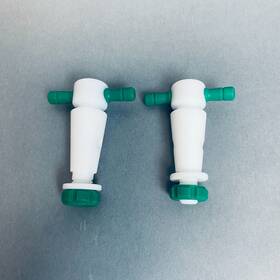
( Brand: Chemglass ), ( Manufacturer Part Number: CG-424-73 ), ( Part Type: Stopcock Plug ), ( Unit Type: Unit ), ( Country Of Origin: United States ), ( Intended Use/discipline: Biological Laboratory, Dental Laboratory, Medical Laboratory, Microbiological Laboratory, Physical Laboratory )
Review CHEMGLASS Ptfe Stopcock 6mm Bore 16/35 Plug Size Lot Of Stopcocks
The **Chemglass CG-424-73 PTFE Stopcock with 16/35 Plug Stopcocks** is a precision-engineered, high-performance valve designed for demanding laboratory applications where reliability, chemical resistance, and leak-free performance are paramount. Constructed from **polytetrafluoroethylene (PTFE)**, this stopcock offers an unmatched combination of inertness and durability, making it ideal for use with aggressive solvents, strong acids, bases, and high-purity reagents where traditional glass or rubber components would degrade or fail. The **16/35 joint standard** ensures seamless compatibility with a vast array of glassware, including condensers, adapters, and reaction vessels, while the **PTFE plug mechanism** provides smooth, frictionless operation even after prolonged use or repeated cycling. Unlike conventional stopcocks that rely on rubber gaskets or cork seals, this design eliminates the risk of contamination or cross-reactivity, making it a preferred choice in pharmaceutical synthesis, analytical chemistry, and materials science. The **smooth, tapered PTFE plug** allows for precise flow control, reducing dead volume and minimizing sample loss during transfers or reactions, while the **reinforced PTFE body** resists warping or deformation under thermal stress, ensuring consistent performance across a wide temperature range. Whether used in routine laboratory procedures or specialized applications such as vacuum distillation, solvent extraction, or high-pressure reactions, the **Chemglass CG-424-73** delivers exceptional longevity and chemical compatibility, reinforcing its status as a cornerstone component in modern glassware assemblies. Its robust construction and inert properties make it an indispensable tool for researchers seeking both efficiency and purity in their experimental workflows.
**Pros and Cons of buying a Chemglass CG-424-73 PTFE Stopcock (16/35 Plug Stopcocks)**
### **Pros**
1. **High Chemical Resistance** The PTFE (polytetrafluoroethylene) construction ensures compatibility with a wide range of aggressive chemicals, acids, bases, and solvents, making it ideal for laboratory applications.
2. **Durability and Longevity** PTFE is highly resistant to corrosion, wear, and temperature fluctuations, extending the stopcock s service life compared to glass or rubber alternatives.
3. **Low Permeability** PTFE has minimal gas and vapor permeability, which is critical for experiments requiring an airtight seal, such as vacuum systems or gas chromatography.
4. **Smooth Operation** The design allows for precise control of flow with minimal friction, reducing the risk of leaks or blockages over time.
5. **Compatibility with Standard Glassware** The 16/35 joint size is a common laboratory standard, ensuring easy integration with other glassware, adapters, and connectors.
6. **Reusable and Maintainable** Unlike disposable stopcocks, this model can be cleaned and reused, making it cost-effective for frequent use.
7. **Temperature Resistance** PTFE remains stable across a broad temperature range (typically -200 C to 260 C), suitable for both cryogenic and high-temperature applications.
8. **Non-Stick Surface** The PTFE coating prevents residue buildup, simplifying cleaning and reducing contamination risks in sensitive experiments.
### **Cons**
1. **Limited Pressure Rating** While PTFE is strong, it may not handle extremely high pressures as effectively as metal or reinforced glass stopcocks, which could be a limitation in high-pressure applications.
2. **Potential for Wear Over Time** Although durable, the PTFE plug and seat may eventually wear down with prolonged or heavy use, requiring eventual replacement.
3. **Cost Compared to Basic Alternatives** PTFE stopcocks are more expensive than simpler glass or rubber stopcocks, which may not be justified for low-budget or non-corrosive applications.
4. **Not Ideal for High-Vacuum Systems** While PTFE performs well in many vacuum applications, it may outgas slightly under extreme vacuum conditions, potentially introducing contaminants.
5. **Limited Color Coding** Unlike some glass stopcocks, PTFE models lack built-in color indicators for flow direction or function, requiring external labeling.
6. **Potential for PTFE Contamination** In highly sensitive applications (e.g., trace analysis), trace amounts of PTFE particles or leachates could theoretically interfere with results, though this is rare with high-quality PTFE.
7. **Specialized Maintenance** Unlike glass, PTFE cannot be easily repaired with heat or annealing; damaged parts may require full replacement.
### **Conclusion**
The **Chemglass CG-424-73 PTFE stopcock** is an excellent choice for laboratories requiring **chemical resistance, durability, and precision control** in applications involving corrosive substances, solvents, or temperature extremes. Its **low permeability, smooth operation, and compatibility with standard glassware** make it a versatile tool for general laboratory use, particularly in chemistry, biochemistry, and materials science. However, if the application involves **extremely high pressures, ultra-high vacuum, or cost-sensitive environments**, alternative materials (e.g., glass, metal, or reinforced PTFE) may be more suitable.
### **Recommendation**
**Buy the Chemglass CG-424-73 PTFE stopcock if:**- You work with **corrosive chemicals, solvents, or require a long-lasting, low-maintenance stopcock**.
- Your setup uses **16/35 glass joints**, ensuring seamless integration.
- You prioritize **chemical inertness, temperature resistance, and smooth operation** over cost.
- You need a **reusable, high-performance alternative** to disposable or less durable stopcocks.
**Consider alternatives if:**- Your application demands **ultra-high vacuum or extreme pressure** (e.g., >100 psi), where metal or reinforced glass stopcocks may be better.
- Budget constraints are critical, and you can use a **simpler glass or rubber stopcock** for non-corrosive liquids.
- You require **built-in flow indicators** (e.g., color-coded glass stopcocks).
For most **general-purpose laboratory use**, this PTFE stopcock is a **highly recommended investment** due to its reliability and versatility.
Details:
Chemglass CG-424-73 PTFE Stopcock 6mm Bore 16/35 Plug Size Lot of 2 Stopcocks.
part #: cg42473 prices
- $55.00-$89.99
specifications plasticwarelabsuppy:
- brand: Chemglass
- mpn: Cg-424-73
- part type: Stopcock Plug
- unit type: Unit
- country of origin: United States
- intended use/discipline: Biological Laboratory, Dental Laboratory, Medical Laboratory, Microbiological Laboratory, Physical Laboratory
general plasticwarelabsuppy:
- condition: Used
- Medical, Lab Dental Supplies > Glassware Plasticware > Other Medical Lab Glassware
returns plasticwarelabsuppy:
- paid by: Buyer
- policy: Returns Accepted
- time: 30 Days
- method: Money back
shipping plasticwarelabsuppy:
- class: Standard, Expedited
- cost: $0.00
- transit: 3-9 Days
- carrier: USPS
- type: Fixed
- service: USPS Ground Advantage, Expedited
payments plasticwarelabsuppy:
- other
- wallet: Google-pay
- credit card: Mastercard
offer plasticwarelabsuppy:
- availability: In Stock
- started: March 25, 2026
- options: Ship-to-home
- sold: 0
- quantity: 1
- best offers: True
seller plasticwarelabsuppy:
- city: Ponder, Texas
- # reviews: 2277
- rating: 100.0%
Chemglass CG-424-73 Is Similar To:
- Cg-1049-j-30 Chemglass Series Vacuum Adapter Outer To Gpi Thread Ptfe Stopcock (30.8% similar) Please for more details the unique design of long stem filter funnel and vacuum adapter makes it unnecessary to clean after each use. Hose connection is 10MM OD at the largest serration. The 2MM ptfe stopcock between outer joint and standard taper inner permits control of vacuum source...(January 17th, 2019)
- Cg-150-04 05 06 Chemglass Lot Of New Stainless Steel Pinch Clamps And (28.6% similar) Included in lot Chemglass cg stainless steel pinch clamps. Lot of 5 new Chemglass stainless steel pinch clamps cg, 05 and clamp. 2 Chemglass cg 18L stainless steel pinch clamps...(December 10th, 2018)
- Cg 1714 16 Chemglass Graduated Addition Funnel Ptfe Valve (26.7% similar) Chemglass cg 1714 16250ML graduated pressure-equalizing addition funnel ptfe valve top and bottom joints glow 100 INF19...(April 6th, 2019)
- Cg-2077-g-02 Chemglass 29-42 Joint Ptfe (30.8% similar) Thorough cleaning and sterilization are recommended before use. Multiple available. Used glassware will show signs of wear sometimes including light scratches, discoloration, stickers tape, or exterior markings. Brand: Chemglass part: CG-2077-G-02 joint: 29 42 inner material: ptfe includes: peek ...(December 1st, 2017)
- Cg-2077-g-04 Chemglass 45-50 Joint Ptfe (29.1% similar) In good condition otherwise. Thorough cleaning and sterilization are recommended before use. Brand: Chemglass part: CG-2077-G-04 joint: 45 50 inner material: ptfe includes: peek compression spring sleeve - for use with 10MM shafts not included used yellow discoloration on the joint, some residue and...(December 1st, 2017)
- Cg-3000-14 Chemglass Lot Hollow Stopper (29.1% similar) This lot 5 Chemglass cg hollow stopper appear to be in good cosmetic condition with little no signs of prior use, only storage wear. However, I really lack the knowledge and equipment to test them, so due little testing, they are being sold as-is. No software, power cords, or other accessories are ...(March 7th, 2019)
- Cg-3002-l-14 Chemglass 14 Solid Ptfe (28.1% similar) Thorough cleaning and sterilization are recommended before use used glassware will show signs of wear sometimes including light scratches, discoloration, stickers tape, or exterior markings. Size: 14, 14 20 joint - ptfe stopper has a polypropylene extraction nut permitting easy removal of the from ...(November 30th, 2017)
- Cg-363-03 Chemglass Plastic 15 Ptfe (26.5% similar) 40MM length . Thorough cleaning and sterilization are recommended before use. Great used condition. Used items will show signs of wear sometimes including light scratches, discoloration, stickers tape, or exterior markings...(January 25th, 2018)
- Cg-410-03 Chemglass Stopcock With Glass Plug Bore Od Sidearms Stopckcock (52% similar) Stopcock has three sidearms sealed 90 apart. For sale is one new old stock Chemglass t-bore stopcock with a glass plug, 4MM bore, 17 40 plug size, 10MM OD sidearms, 4 clip size. No outer box or literature. To make sure you are getting an accurate quote via the shipping calculator, your zip code is ...(March 17th, 2019)
- Cg-410-88 Chemglass Glass Plug For Joints Stopcock (34.4% similar) Chemglass cg glass plug for joints stopcock 4MM V11 new - open box fast shipping...(October 14th, 2018)
- Cg-9800-01 Chemglass Nib Model Organic Chemistry Labkit Size (30.4% similar) Chemglass cg includes each of following items: CG-1078-01ADAPTER, inlet, bleed tube, 7MM OD x 265MM AOL CG-1020-14ADAPTER, clause, 14 20 joint size, 117MM70MM WCG-1022-14ADAPTER, distillation, side inner at 75 CG-1038-14ADAPTER, thermometer, joint, 55MM height CG-1050-14ADAPTER, vacuum take-off, a...(October 18th, 2018)