LABPURE BY SAINT GOBAIN D1069543 Pfa Evaporating Dish 100ML Chemical Laboratory
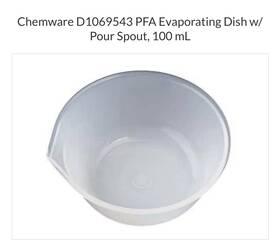
( Brand: Labpure By Saint Gobain ), ( Manufacturer Part Number: D1069543 ), ( Model: 100ML ), ( Part Type: Chemical ), ( Intended Use/discipline: Biological Laboratory, Chemical Laboratory )
Review LABPURE BY SAINT GOBAIN Pfa Evaporating Dish Biological Chemical Laboratory
The **LabPure Saint-Gobain D1069543 PFA Evaporating Dish (100 mL)** is a high-performance laboratory evaporating dish designed for precision and durability in demanding chemical and analytical applications. Crafted from **perfluoroalkoxy (PFA)**, a premium fluoropolymer material, this dish combines exceptional chemical resistance with outstanding thermal stability, making it ideal for use with aggressive solvents, strong acids, and bases, as well as high-temperature processes. The PFA composition ensures minimal contamination risk, as it is inert to virtually all common reagents, including hydrofluoric acid, concentrated sulfuric acid, and organic solvents, while also exhibiting excellent resistance to corrosion and degradation over repeated use. Its smooth, non-porous surface further prevents adsorption of residues, ensuring consistent and reliable results in evaporation, digestion, and sample preparation procedures.
With a **100 mL capacity**, this evaporating dish strikes an optimal balance between utility and workspace efficiency, accommodating standard laboratory volumes while allowing for easy handling and placement on hot plates, heating mantles, or under fume hoods. The dish s **flat-bottom design** promotes even heating, reducing the risk of hot spots and ensuring uniform evaporation rates, which is critical for applications requiring precise solvent removal or sample concentration. The robust construction of PFA also provides exceptional thermal shock resistance, allowing for rapid temperature changes without compromising structural integrity a feature particularly valuable in scenarios involving sudden cooling or heating cycles. Additionally, the material s low surface energy minimizes sample adhesion, simplifying cleanup and reducing the potential for cross-contamination between experiments.
Beyond its technical advantages, the **LabPure Saint-Gobain D1069543** is engineered for long-term reliability, with a design that resists warping, cracking, or degradation even under prolonged exposure to harsh conditions. Its compatibility with autoclaving and sterilization protocols further extends its usability in microbiological and pharmaceutical applications where sterility is paramount. The dish s sleek, transparent appearance allows for easy visual monitoring of evaporation progress, while its smooth finish ensures compatibility with most laboratory glassware and accessories, including clamps, condensers, and heating elements. Whether used in routine analytical chemistry, environmental testing, or specialized research, this evaporating dish exemplifies the precision and resilience required in modern laboratory environments, offering a durable, contamination-free solution for critical evaporation and concentration tasks.
### **Pros and Cons of buying a LabPure Saint-Gobain D1069543 PFA Evaporating Dish (100ml) for Chemical Laboratory Use**
#### **Pros**
1. **High Chemical Resistance** Made from **PFA (Perfluoroalkoxy Alkane)**, a fluoropolymer known for its exceptional resistance to corrosive chemicals, including strong acids, bases, and organic solvents. This makes it ideal for aggressive laboratory applications.
2. **Temperature Stability** PFA has a high thermal stability, typically operating safely up to **260 C (500 F)** without degradation. This allows for heating, drying, or evaporation processes without fear of material breakdown.
3. **Inert and Non-Reactive** Unlike glass or certain plastics, PFA does not react with most chemicals, preventing contamination of samples. This is crucial in analytical chemistry, pharmaceutical testing, and trace analysis.
4. **Durability and Longevity** PFA is highly resistant to wear, cracking, or leaching, ensuring a long service life even with frequent use. It is also more impact-resistant than glass, reducing the risk of breakage.
5. **Easy to Clean and Sterilize** The smooth, non-porous surface of PFA prevents residue buildup, making it easy to clean with solvents or autoclave for sterilization. This is beneficial in microbiology and sterile sample preparation.
6. **Compatibility with Autoclaving** Unlike some plastics, PFA can withstand repeated autoclaving (steam sterilization), making it suitable for laboratory environments requiring sterile conditions.
7. **Low Extractables** PFA has minimal leachable impurities, which is important for applications where sample purity is critical, such as in **HPLC (High-Performance Liquid Chromatography) sample preparation** or **mass spectrometry**.
8. **Seamless Construction** The dish is likely **welded or molded in one piece**, eliminating seams where contaminants could accumulate a common issue with some plastic or glassware.
9. **Lightweight Yet Sturdy** Compared to glass, PFA is lighter, reducing handling fatigue, while still being robust enough for routine laboratory use.
10. **Wide Chemical Compatibility** Works with a broad range of solvents, including **acetone, methanol, ethanol, hydrochloric acid, sulfuric acid, and many organic compounds**, making it versatile for different experiments.
---
#### **Cons**
1. **Higher Cost** PFA is significantly more expensive than alternatives like **borosilicate glass, polypropylene (PP), or polyethylene (PE)**. The premium price may be a barrier for budget-conscious laboratories.
2. **Limited UV Transparency** Unlike quartz or borosilicate glass, PFA is **not transparent to UV light**, which may limit its use in applications requiring UV spectroscopy or photochemical reactions.
3. **Not Suitable for High-Pressure Applications** While PFA is strong, it is not designed for **high-pressure environments** (e.g., autoclaves with excessive pressure or specialized reactors). It is best for atmospheric or low-pressure operations.
4. **Potential for Cold Flow Under Prolonged Stress** Although rare, PFA can exhibit **creep (permanent deformation) under constant mechanical stress** over long periods. This is more of a concern in large-scale industrial settings than in typical lab use.
5. **Limited Availability of Custom Sizes** Standard sizes (like 100ml) are common, but **custom or non-standard shapes may be harder to source** compared to glassware, which is widely available in various forms.
6. **Not Ideal for Open-Flame Heating Without Caution** While PFA can withstand high temperatures, **direct open-flame heating (e.g., Bunsen burner) may cause localized overheating or thermal stress** if not done carefully. Electric or hot plate heating is preferred.
7. **Potential for Static Charge Buildup** Some fluoropolymers can generate static electricity, which may be problematic in **electrostatic-sensitive applications** (e.g., certain electronics or aerosol work).
8. **Not as Visually Inspectable for Contamination** Unlike glass, PFA is opaque, so **internal contamination or residue may not be visible** without cleaning or further testing.
9. **Environmental Considerations** PFA is a **synthetic polymer**, and while it is chemically inert, its production and disposal may raise **environmental concerns** compared to recyclable glass.
10. **Potential for Compatibility Issues with Certain Extremely Reactive Compounds** While PFA is highly resistant, **fluorine gas, molten alkali metals, or highly exothermic reactions** may still pose risks that require additional precautions.
---
### **Conclusion**
The **LabPure Saint-Gobain D1069543 PFA Evaporating Dish (100ml)** is an **excellent choice for laboratories requiring extreme chemical resistance, high-temperature stability, and inert sample handling**. Its advantages in **corrosion resistance, durability, and cleanability** make it ideal for **analytical chemistry, pharmaceutical testing, environmental analysis, and any application involving aggressive solvents or acids**.
However, its **higher cost, lack of UV transparency, and limited pressure tolerance** may make it less suitable for **budget-conscious labs, UV-dependent experiments, or high-pressure applications**. If the primary concern is **cost efficiency or visibility**, alternatives like **borosilicate glass (e.g., Kimax or Pyrex) or high-quality polypropylene** may be considered.
For most **serious chemical laboratories dealing with harsh conditions**, the **investment in PFA is justified** due to its reliability and longevity.
---
### **Recommendation**
**Buy the LabPure Saint-Gobain PFA Evaporating Dish if:**You work with **strong acids, bases, or organic solvents** that would degrade glass or plastic.
Your experiments involve **high-temperature evaporation, drying, or heating** (up to 260 C).
**Sample purity is critical** (e.g., trace analysis, HPLC, mass spectrometry).
You require **durability and long-term use** without frequent replacements.
Your lab frequently **autoclaves or sterilizes equipment**.
**Consider Alternatives (e.g., borosilicate glass or polypropylene) if:**Your budget is **limited**, and glass or plastic is sufficient for your chemicals.
You need **UV transparency** for spectroscopic applications.
Your work involves **high-pressure reactions** (e.g., sealed systems).
You frequently handle **large volumes or non-standard shapes** where PFA may not be cost-effective.
**Final Verdict:** For **high-end chemical laboratories prioritizing chemical resistance and reliability**, the **PFA evaporating dish is a strong recommendation**. For **general-purpose or cost-sensitive labs**, a **high-quality borosilicate glass dish** may suffice. Always ensure compatibility with your specific chemicals and procedures before purchase.
Details:
LabPure PFA Evaporating Dish 100mL D1069543 Biological Chemical Laboratory.
part #: d1069543 price
- $53.00
specifications plasticwarelabsuppy:
- brand: Labpure By Saint Gobain
- mpn: D1069543
- model: 100ml
- part type: Chemical
- intended use/discipline: Biological Laboratory, Chemical Laboratory
seller plasticwarelabsuppy:
- city: Fox River Grove, Illinois
- # reviews: 251
- rating: 100.0%
shipping plasticwarelabsuppy:
- carrier: USPS
- type: Calculated
- cost: $8.06
- service: USPS Ground Advantage
- class: Standard
- transit: 3-9 Days
returns plasticwarelabsuppy:
- policy: No Returns
offer plasticwarelabsuppy:
- availability: In Stock
- quantity: 3
- sold: 0
- options: Ship-to-home
- started: April 29, 2026
general plasticwarelabsuppy:
- Medical, Lab Dental Supplies > Glassware Plasticware > Other Medical Lab Glassware
- condition: New Open box
payments plasticwarelabsuppy:
- other
- money order
- credit card: Discover
- wallet: Apple-pay