SYNTHWARE GLASS D451410 Distillation Receiver Dean Stark Ptfe 190 65 14/20
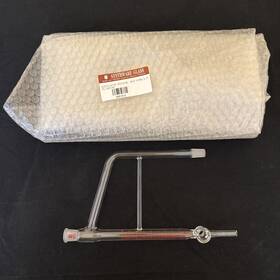
( Brand: Synthware Glass ), ( Manufacturer Part Number: D451410 ), ( Part Type: Receiver ), ( Intended Use/discipline: Biological Laboratory, Dental Laboratory, Medical Laboratory, Microbiological Laboratory, Physical Laboratory )
Review SYNTHWARE GLASS Distillation Receiver Dean Stark Ptfe 190 65 14/20
The **Synthware Glass Dean-Stark Distillation Receiver (Model D451410, PTFE 190/65, 14/20 Joint)** is a high-performance laboratory accessory meticulously engineered for precise and efficient solvent removal, dehydration, or azeotropic distillation processes. Constructed from durable **borosilicate glass Type 3.3**, this receiver combines exceptional chemical resistance, thermal stability, and optical clarity to ensure reliable performance across a wide range of applications, from organic synthesis and pharmaceutical development to polymer chemistry and analytical testing. The **PTFE-coated internal surfaces** (rated for temperatures up to 190 C and pressures up to 65 psi) provide an inert barrier that prevents corrosion, minimizes residue buildup, and eliminates the risk of catalytic degradation, making it ideal for handling aggressive solvents like alcohols, ketones, or acidic mixtures. Its **14/20 standard ground glass joint** ensures a secure, leak-proof connection to compatible distillation setups, while the **smooth, tapered design** facilitates efficient condensation and phase separation, reducing the risk of clogging or backflow during operation. The receiver s **graduated markings** allow for accurate volume measurements, enabling precise monitoring of solvent recovery or reaction progress, while its **robust construction** reinforced with a sturdy base and reinforced neck ensures stability even under moderate vacuum or pressure conditions. Whether used in conjunction with a Dean-Stark trap for water removal, as part of a reflux system, or for solvent evaporation under reduced pressure, this receiver delivers unmatched reliability and versatility, making it an indispensable tool for laboratories demanding both performance and durability. Its compatibility with standard laboratory glassware and adaptability to various distillation configurations further solidify its place as a cornerstone piece in any advanced chemical research or industrial-scale synthesis workflow.
**Pros and Cons of buying a Synthware Glass Dean-Stark Distillation Receiver (D451410, PTFE, 190/65, 14/20 Joint)**
### **Pros**
1. **High-Quality Construction** The receiver is made from borosilicate glass (likely Type 3.3 or similar), which is durable, resistant to thermal shock, and chemically inert. This ensures longevity and reliability in laboratory settings.
2. **PTFE-Coated Interior** The PTFE (polytetrafluoroethylene) lining prevents corrosion, reduces residue buildup, and makes cleaning easier. This is particularly useful for reactions involving aggressive solvents or acids.
3. **Standardized Joint Compatibility** The 14/20 joint size is widely compatible with most laboratory glassware, making it easy to integrate into existing setups without needing adapters.
4. **Efficient Condensation and Separation** The Dean-Stark design is optimized for azeotropic distillation, allowing for effective water removal from reaction mixtures (e.g., in esterification or dehydration reactions). The curved condenser ensures good phase separation.
5. **Temperature Resistance** The borosilicate glass and PTFE coating can withstand high temperatures (up to 200 C or more, depending on the exact glass type), making it suitable for a variety of reactions.
6. **Chemical Resistance** The combination of glass and PTFE resists most organic solvents, acids, and bases, reducing the risk of contamination or degradation.
7. **Transparency and Visibility** Glass construction allows for clear observation of the reaction progress, phase separation, and any potential issues (e.g., clogging or leaks).
8. **Compatibility with Vacuum and Pressure** The design can often handle slight pressure variations, though extreme conditions should be checked against the manufacturer s specifications.
9. **Easy to Clean and Maintain** The smooth PTFE surface prevents sticking, and the glass can be cleaned with standard laboratory solvents or mild detergents.
10. **Cost-Effective for Laboratory Use** While not the cheapest option, it offers a balance of durability and functionality that justifies its price for serious laboratory work.
---
### **Cons**
1. **Fragility** Despite its strength, borosilicate glass can still shatter if subjected to sudden thermal shock (e.g., rapid cooling after heating) or mechanical impact. Care must be taken during handling and assembly.
2. **Limited Pressure Tolerance** While it can handle minor pressure fluctuations, it is not designed for high-pressure applications. Overpressurization could lead to failure.
3. **Weight and Bulk** Glassware is heavier than plastic alternatives, which can make setup and transport more cumbersome, especially for large-scale or frequent use.
4. **Potential for Leaks** If the joints are not properly lubricated (e.g., with high-vacuum grease or silicone grease) or if the glassware is damaged, leaks can occur, compromising the reaction.
5. **Cost Compared to Plastic Alternatives** While durable, glass Dean-Stark receivers are more expensive than plastic versions (e.g., polypropylene). Plastic may be preferable for low-budget or non-acidic applications.
6. **Maintenance of Joints** The 14/20 joints require periodic cleaning and lubrication to prevent sticking or sealing issues, adding slight maintenance overhead.
7. **Not Ideal for Highly Corrosive Environments** While PTFE helps, extremely aggressive chemicals (e.g., concentrated hydrofluoric acid or strong oxidizers) may still pose risks over time.
8. **Limited Availability of Replacement Parts** If the glassware cracks or the PTFE lining degrades, finding exact replacements may be difficult, especially for specialized sizes.
9. **Safety Risks During Use** Improper handling (e.g., overfilling, sudden temperature changes) can lead to accidents, such as spills or breakage, requiring caution.
10. **Not Suitable for All Reactions** For reactions requiring extreme conditions (e.g., very high temperatures or pressures beyond the glassware s limits), alternative setups (e.g., stainless steel or specialized glassware) may be necessary.
---
### **Conclusion**
The Synthware Glass Dean-Stark Distillation Receiver (D451410) is a high-quality, reliable piece of laboratory glassware ideal for azeotropic distillation, dehydration reactions, and other processes requiring efficient water removal. Its borosilicate glass construction and PTFE lining provide durability, chemical resistance, and ease of cleaning, making it a strong choice for academic, industrial, or hobbyist laboratories. However, its fragility, weight, and cost compared to plastic alternatives mean it may not be the best fit for every application.
For users who prioritize **durability, chemical resistance, and transparency** in their distillation setups, this receiver is an excellent investment. For those working with **highly corrosive substances, extreme pressures, or budget constraints**, a plastic alternative or a different glassware design might be more appropriate.
---
### **Recommendation**
**Buy this receiver if:**- You need a **long-lasting, chemically resistant** setup for azeotropic distillation or dehydration reactions.
- Your work involves **organic solvents, acids, or bases** where PTFE and borosilicate glass provide protection.
- You value **visibility and ease of monitoring** during reactions.
- You are willing to invest in **high-quality laboratory glassware** for reliable performance.
**Consider alternatives if:**- You work with **extremely high pressures or temperatures** beyond the glassware s limits.
- You need a **lighter, more cost-effective** solution (e.g., polypropylene Dean-Stark receivers).
- Your reactions involve **highly corrosive or abrasive chemicals** that may degrade the PTFE or glass over time.
- You frequently handle **large volumes** where the weight of glassware becomes impractical.
For most **serious laboratory users**, this receiver is a worthwhile purchase due to its balance of performance and durability. Always ensure proper assembly, lubrication, and handling to maximize its lifespan and safety.
Details:
Shipped with USPS Ground Advantage. Condition is New. Synthware Glass Stopcock, 1:5 Teflons, T-BORE, 2mm, 15.
part #: d451410 prices
- $84.96-$101.96
specifications plasticwarelabsuppy:
- brand: Synthware Glass
- mpn: D451410
- part type: Receiver
- intended use/discipline: Biological Laboratory, Dental Laboratory, Medical Laboratory, Microbiological Laboratory, Physical Laboratory
general plasticwarelabsuppy:
- condition: New Open box
- Medical, Lab Dental Supplies > Glassware Plasticware > Other Medical Lab Glassware
returns plasticwarelabsuppy:
- policy: No Returns
offer plasticwarelabsuppy:
- quantity: 4
- best offers: True
- sold: 0
- availability: In Stock
- options: Ship-to-home
- started: April 5, 2026
shipping plasticwarelabsuppy:
- type: Calculated
- transit: 5-11 Days
- carrier: USPS
- service: USPS Ground Advantage
- class: Standard
- cost: $14.00
payments plasticwarelabsuppy:
- wallet: Google-pay
- other
- credit card: Discover
seller plasticwarelabsuppy:
- city: Tucson, Arizona
- # reviews: 1767
- rating: 99.4%
Synthware Glass D451410 Is Similar To:
- C102441 Kemtech Vigreux Distillation Column Joints Synthware (31.9% similar) Check them out. I will combine shipping. Vigorous distillation column 200MM joints by Comte Synthware C102441 in great condition. 350MM total length , 200MM indented area joints both ends, no chips or cracks. Sometimes this is a fast option and its not, depending on the package. I'll default to ...(September 2nd, 2019)
- Synthware Glass F624125 125ml Pressure Equal Funnel 24 40 New (36% similar) Synthware Glass 125ML pressure equal funnel 24/40 new F624125...(September 19th, 2024)
- Synthware Glass C204100 Condenser Liebig 24 40 100mm (49.2% similar) Shipped with USPS ground advantage. C204100 Synthware Glass condenser, lie big, 24/40 100MM. Condition is new...(November 7th, 2024)
- Synthware Kemtech America Synm431005 5 Port Glass Vacuum M260003 Manifold With High Vac Stopcocks 450mm Nib (30.3% similar) The manifold includes high vacuum stopcocks and measures 450MM in size, providing a reliable efficient solution for handling inert gas applications laboratory settings. Available on at $441.48 including shipping. Only opened for photos here. It is designed for use in various laboratory disciplines ...(January 2nd, 2025)
- Synthware F621125 Pressure Equalizing Addition Funnel 14 20 125 Ml With Ptfe Stopcock (33.1% similar) Synthware F621125 pressure equalizing addition funnel 14/20 125 ml with ptfe stopcock...(June 20th, 2025)
- Synthware Synd451414-1ea Dean Stark Reciever 14 20 New (53% similar) SYND451414-1EA, dean stark receiver, 14/20, new. Shipped with FedEx ground / home delivery...(December 19th, 2025)
- Synthware A381420 Flow Control Adapter 24 40 Lower Hose Barb Upper With Ptfe Stopcock (37.6% similar) Joint size: 24/40 standard taper. Features: provides a reliable interface between Glassware and flexible tubing. Hose connection: bent sidearm for secure tubing attachment. Applications: vacuum or inert gas lines. Keywords for SRO: Synthware hose adapter, 24/40 Glass bent connection, stopcock ...(December 29th, 2025)
- Synthware A372440 Claisen 3-way Adapter Connecting Distillation Head 24 40 (45.5% similar) Durable construction for repeated laboratory use. Specifications: model: A372440. Material:high-quality brisket Glass for superior thermal and chemical resistance. Precision-ground joints for secure, leak-free connections. Multi-component distillation assemblies. Shipping packaging: carefully ...(December 29th, 2025)
- Synthware D251014 Microscale Distillation Apparatus Vigreux Design New (47.3% similar) High-quality brisket Glass for superior chemical and thermal resistance.: vigorous indentations for enhanced . Joints:thermometer joint: 10/18. Design: short-path with vigorous indentations. Model: D251014. Ships securely with protective packaging, fast handling and delivery. Perfect for ...(January 5th, 2026)
- Synthware 41029-f Glass Stopcock With Ptfe Valve Straight Bore 4mm 1 5 Taper New (37.5% similar) Shipping handling: ships securely with protective packaging. Glass type: 3.3 brisket for durability and thermal stability. Compatible with standard Glassware assemblies. Perfect for high-vacuum or controlled flow applications in laboratory setups. Key features: brand: Synthware. No chips, cracks, or...(January 5th, 2026)
- Synthware D261024 Short-path Distillation Apparatus 24 40 Joints New (46.6% similar) Design: one-piece for quick setup. Condition: new. Ships securely with protective packaging, fast handling and delivery.: one-piece design reduces setup time and minimizes leaks. Perfect for small-scale distillation and solvent recovery. Ideal for teaching labs, research, and organic synthesis. ...(January 5th, 2026)