CHEMGLASS CG-1402-27 Glass Frit Buchner Filter Funnel 600ML
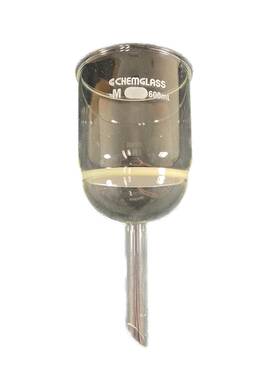
( Brand: Chemglass ), ( Manufacturer Part Number: CG-1402-27 ), ( Part Type: Filter ), ( Intended Use/discipline: Biological Laboratory, Dental Laboratory, Microbiological Laboratory, Medical Laboratory, Physical Laboratory ), ( Country Of Origin: United States ), ( Unit Type: Unit ), ( Additional Information: Surplus Laboratory Consumable Supplies )
Review CHEMGLASS Glass 600ml Frit Buchner Filter Funnel
The Chemglass CG-1402-27 Glass 600 mL Frit Buchner Filter Funnel is a precision-engineered laboratory tool designed for efficient and reliable filtration processes in chemical, biological, and pharmaceutical research settings. Crafted from high-quality borosilicate glass (Type 1, conforming to ASTM E438 and USP Class A standards), this funnel is built to withstand the rigors of routine laboratory use while maintaining exceptional chemical resistance and thermal stability. The robust construction ensures durability across a wide range of applications, from routine filtration tasks to more demanding procedures involving corrosive solvents or elevated temperatures.
Featuring a standard 27/40 joint, this funnel seamlessly integrates with a variety of glassware, including filter flasks, allowing for a secure and leak-proof connection that minimizes contamination risks. The 600 mL capacity provides ample space for medium to large-scale filtrations, making it ideal for experiments requiring moderate volumes without sacrificing precision. The integral frit, typically composed of fine glass beads or sintered glass, offers consistent pore size uniformity, ensuring reproducible filtration rates and minimal clogging. This design facilitates rapid and thorough separation of solids from liquids, whether in vacuum-assisted or gravity filtration applications.
The funnel s ergonomic handle, positioned at a practical angle, enhances ease of use and stability during filtration, reducing the risk of spills or accidental dislodgment. Its transparent borosilicate construction allows for real-time monitoring of the filtration process, enabling operators to track progress and adjust parameters as needed. Additionally, the smooth, polished interior surfaces promote easy cleaning and maintenance, extending the funnel s lifespan while adhering to stringent laboratory hygiene standards. Whether used in routine synthesis, analytical chemistry, or preparative work, the Chemglass CG-1402-27 delivers consistent performance and reliability, making it an indispensable component in any well-equipped laboratory.
The Chemglass CG-1402-27 glass Buchner funnel (600 mL) is a widely used piece of laboratory glassware for vacuum filtration. Below is a detailed breakdown of its pros and cons, followed by a conclusion and recommendation.
---
**Pros:**1. **Durability and Chemical Resistance**: Made from borosilicate glass (likely Type 1 or 3), this funnel is highly resistant to most acids, bases, and organic solvents. It can withstand harsh chemical environments without degrading or leaching contaminants, making it ideal for a broad range of laboratory applications.
2. **Precision and Clarity**: The clear glass allows for easy visualization of the filtration process, including the progress of filtration and the clarity of the filtrate. This is particularly useful for monitoring reactions or ensuring complete separation of solids and liquids.
3. **Compatibility with Standard Laboratory Equipment**: The funnel is designed to fit standard vacuum filtration setups, including vacuum pumps, filter flasks (e.g., Buchner flasks), and rubber stoppers. Its dimensions (27 mm stem diameter) ensure a secure and leak-proof connection to typical laboratory glassware.
4. **Reusability**: Glass is a reusable material, and with proper care (e.g., cleaning with water, mild detergents, or organic solvents), this funnel can be used repeatedly over many experiments. This reduces long-term costs compared to disposable alternatives.
5. **Temperature Resistance**: Borosilicate glass can withstand high temperatures, making it suitable for filtration of hot solutions or sterilization procedures (e.g., autoclaving, though avoid sudden thermal shocks).
6. **Compatibility with Analytical Techniques**: The funnel s design is compatible with techniques requiring precise filtration, such as gravimetric analysis, recrystallization, or sample preparation for chromatography or spectroscopy.
7. **Longevity**: High-quality glassware like this is built to last for years, even with frequent use, provided it is handled carefully to avoid breakage.
---
**Cons:**1. **Fragility**: Glass is brittle and can shatter if dropped or subjected to sudden impacts. This makes it less suitable for rough handling or environments where mechanical stress is a concern. It also requires careful storage to prevent damage.
2. **Weight**: Glass is heavier than plastic alternatives, which can make handling cumbersome, especially during frequent transfers or when working with large volumes. This may contribute to user fatigue over extended periods.
3. **Cleaning Time**: Glassware requires thorough cleaning to remove residues, particularly if sticky or insoluble materials are filtered. This can be time-consuming, especially if the funnel is clogged or if the filtrate contains oils or polymers. Some contaminants may require organic solvents or ultrasonic cleaning.
4. **Cost**: While reusable, the initial purchase price of high-quality glassware like this funnel is higher than disposable alternatives (e.g., plastic or paper filters). However, the cost per use decreases significantly over time with repeated use.
5. **Potential for Contamination**: If not cleaned properly, glassware can harbor residues from previous experiments, leading to cross-contamination. This is particularly critical in sensitive applications like pharmaceutical or biological research.
6. **Limited Flexibility**: Glass is rigid and cannot be bent or reshaped. If the funnel develops cracks or damage, it must be replaced, and there are no DIY repair options.
7. **Safety Risks**: The risk of breakage poses a hazard if the funnel shatters during use, potentially causing cuts or glass contamination in the sample. Proper personal protective equipment (e.g., lab coats, gloves) and careful handling are essential.
8. **Environmental Impact of Disposal**: Although reusable, if the funnel eventually breaks irreparably, disposing of glass requires careful handling to avoid environmental harm (e.g., landfill waste or improper disposal).
---
**Conclusion:**The Chemglass CG-1402-27 glass Buchner funnel is an excellent choice for laboratories requiring high chemical resistance, precision, and durability. Its borosilicate construction ensures compatibility with a wide range of solvents and conditions, making it indispensable for routine filtration tasks such as recrystallization, sample preparation, or analytical separations. The ability to reuse the funnel over many experiments offsets its higher upfront cost, and its clarity and compatibility with standard equipment enhance its utility.
However, its fragility and weight are notable drawbacks, particularly in settings where ease of handling or durability is prioritized over chemical resistance. For laboratories with limited budgets or those prioritizing disposability (e.g., teaching labs or high-throughput screening), plastic alternatives may be more practical. Additionally, users must invest time in proper cleaning and storage to maintain its performance and safety.
---
**Recommendation:** Purchase the Chemglass CG-1402-27 glass Buchner funnel if:- You work in a laboratory where chemical resistance, precision, and reusability are critical (e.g., organic synthesis, analytical chemistry, or pharmaceutical research).
- Your workflow involves frequent filtration of aggressive solvents or high-temperature solutions.
- You have the resources to handle glassware carefully and maintain it properly.
- The long-term cost savings of reusability outweigh the initial investment.
Consider alternatives (e.g., plastic or stainless steel Buchner funnels) if:- You prioritize durability and ease of handling over chemical resistance (e.g., in teaching labs or industrial settings).
- Your budget is constrained, and you can justify the cost of disposable or lower-cost alternatives.
- Your experiments involve non-aggressive solvents or conditions where glass is unnecessary.
For most academic or research laboratories, the CG-1402-27 remains a superior choice due to its reliability and performance. Always pair it with appropriate safety measures (e.g., goggles, gloves) and storage solutions (e.g., protective cases) to mitigate risks.
Details:
No chips or cracks throughout. GSR veers 1730 GS 9.9.4 1730 Used item in great condition. Frit shows minor staining. See pictures for details.
part #: cg140227 prices
- $69.99-$109.99
specifications plasticwarelabsuppy:
- brand: Chemglass
- mpn: Cg-1402-27
- part type: Filter
- intended use/discipline: Biological Laboratory, Dental Laboratory, Microbiological Laboratory, Medical Laboratory, Physical Laboratory
- country of origin: United States
- unit type: Unit
- additional information: Surplus Laboratory Consumable Supplies
seller plasticwarelabsuppy:
- city: Cotati, California
- # reviews: 7608
- rating: 99.9%
offer plasticwarelabsuppy:
- sold: 0
- availability: In Stock
- quantity: 1
- options: Ship-to-home
- started: March 24, 2026
returns plasticwarelabsuppy:
- policy: Returns Accepted
- method: Money back
- time: 30 Days
- paid by: Seller
shipping plasticwarelabsuppy:
- service: USPS First Class, FedEx 2Day, FedEx Standard Overnight
- class: Standard, Expedited, One-day
- transit: 3-8 Days
- carrier: USPS, FedEx
- type: Fixed
- cost: $0.00
payments plasticwarelabsuppy:
- other
- credit card: Mastercard
- wallet: Google-pay
general plasticwarelabsuppy:
- Medical, Lab Dental Supplies > Glassware Plasticware > Other Medical Lab Glassware
- condition: Used
Chemglass CG-1402-27 Is Similar To:
- Cg-1215-a-11 Chemglass Dual Coil Glass Reflux Condenser With Receiving Flask And (42.6% similar) ...(December 22nd, 2018)
- Cg-1215-a-12 Chemglass Glass Reflux Condenser Jacket Length Joint (39.7% similar) This will include powering on the unit and checking all major functions. We check and respond to our messages often. Packaging opened manufacturer. Quality all merchandise is tested prior to listing unless it sealed in the factory package. Does not appear to have been used. This helps our buyers ...(October 27th, 2018)
- Cg-1320-09 Kontes Chemglass Glass Rotary Evaporator Rotovap Bump Trap Joints (35% similar) Chemglass glass 500ML rotary evaporator rooftop bump trap joints condition is used. Shipped with USPS priority mail...(June 9th, 2019)
- Cg 1403-07 Chemglass Jacketed Filter (41.2% similar) Chemglass jacketed filter funnel capacity 60ML porosity m disc OD 40MM stem length 60MM...(May 10th, 2017)
- Cg 1714 16 Chemglass Graduated Addition Funnel Ptfe Valve (37.3% similar) Chemglass cg 1714 16250ML graduated pressure-equalizing addition funnel PDF valve top and bottom joints glow 100 INF19...(April 6th, 2019)
- Cg-1759-26 Chemglass 8 Top Eco-funnel (36.7% similar) New in package, great deal...(August 1st, 2017)
- Cg-1866-05 Chemglass Glass Ml Solid Phase Peptide Synthesis Vessel Medium Frit (34.5% similar) Medium frit, vacuum, t-bore PDF stopcock, 24 40 outer joint.: cg Chemglass cat. No chips, cracks. A used Chemglass 250 ml glass solid phase peptide synthesis vessel in very good condition...(September 30th, 2018)
- Cg-2071-01 Chemglass Glass Connecting Adapter Top Bottom Enlarging (39.4% similar) Great used condition. Used items will show signs of wear sometimes including light scratches, discoloration, stickers tape, or exterior markings...(December 8th, 2018)
- Cg-4023-03 Chemglass Connecting Tube Glass Shaped Mm New In Open Box (37.2% similar) 7MM cg new in open box this listing is for a Chemglass connecting tube glass, y shaped, Arlington Hts road, suite 2336ARLINGTON height , il. 7MM cg that is new in open box...(November 9th, 2018)
- Cg-410-03 Chemglass Stopcock With Glass Plug Bore Od Sidearms Stopckcock (36.1% similar) Stopcock has three sidearms sealed 90 apart. For sale is one new old stock Chemglass t-bore stopcock with a glass plug, 4MM bore, 17 40 plug size, 10MM OD sidearms, 4 clip size. No outer box or literature. To make sure you are getting an accurate quote via the shipping calculator, your zip code is ...(March 17th, 2019)
- Cg-410-88 Chemglass Glass Plug For Joints Stopcock (41.4% similar) Chemglass cg glass plug for joints stopcock 4MM V11 new - open box fast shipping...(October 14th, 2018)