CHEMGLASS SY-0502-182JS Tef Stpk Frit Solid Phase Peptide 200ML 24/40 4MM Synthesis Vessel
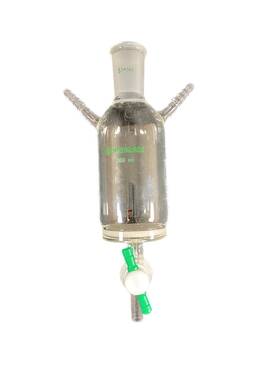
( Brand: Chemglass ), ( Manufacturer Part Number: SY-0502-182JS ), ( Intended Use/discipline: Biological Laboratory, Dental Laboratory, Medical Laboratory, Microbiological Laboratory, Physical Laboratory ), ( Unit Type: Unit ), ( Country Of Origin: United States ), ( Additional Information: Surplus Laboratory Consumable Supplies )
Review CHEMGLASS 200ml 24/40 4mm Tef Stpk Frit Solid Phase Peptide Synthesis Vessel
The **Chemglass SY-0502-182JS 200 mL 24/40 Joint Solid Phase Peptide Synthesis (SPPS) Vessel with 4 mm Teflon -Backed Solid Support Frit** is a precision-engineered reaction vessel meticulously designed for the demanding requirements of modern solid-phase peptide synthesis (SPPS). Crafted from high-quality borosilicate glass (Type 1, Class A), this vessel combines exceptional chemical resistance, thermal stability, and optical clarity to ensure reliable performance across a wide range of synthetic protocols. The **24/40 standard taper joint** facilitates seamless compatibility with a vast array of laboratory glassware, including syringes, filters, and other SPPS accessories, while the **4 mm Teflon -backed solid support frit** provides an efficient and reusable filtration system, preventing clogging and ensuring smooth resin flow during washing and coupling steps. The **200 mL working volume** offers ample capacity for scalable peptide synthesis while maintaining optimal reagent-to-resin ratios, and the **threaded cap with PTFE-lined septum** ensures an airtight, contamination-free environment, critical for sensitive peptide synthesis. Ideal for both manual and automated SPPS workflows, this vessel is engineered to withstand repeated use in harsh organic solvents, strong acids, and bases, making it a durable and versatile tool for researchers, chemists, and laboratories focused on high-purity peptide production. Its robust construction and thoughtful design features such as the reinforced joint and secure sealing mechanism minimize the risk of leaks or breakage, while the **Teflon -backed frit** enhances resin retention and simplifies post-reaction filtration without compromising peptide integrity. Whether employed in routine synthesis or advanced peptide engineering, this vessel delivers the precision, reliability, and ease of use required to achieve high-yield, high-quality results in every synthesis cycle.
**Pros and Cons of buying a Chemglass SY-0502-182JS 200mL 24/40 4mm Teflon-SPK Frit Solid Phase Peptide Synthesis (SPPS) Vessel**
### **Pros:**1. **High-Quality Construction** The vessel is made from borosilicate glass (likely Type 1 or 3.3), which is chemically resistant, durable, and suitable for harsh organic solvents and acidic/basic conditions commonly used in peptide synthesis.
2. **Teflon-Coated Interior** The Teflon (PTFE) coating reduces adsorption of peptides and reagents, minimizing losses and improving yield. It also prevents contamination from glass surfaces, which is critical in peptide synthesis where purity is essential.
3. **SPK Frit Design** The solid-phase support (SPK) frit allows for efficient filtration and washing of resin while retaining it within the vessel. This is ideal for solid-phase peptide synthesis (SPPS), where repeated washing steps are necessary.
4. **Standard 24/40 Joint** The ground-glass joint ensures a secure, leak-proof seal when connected to other glassware (e.g., funnels, adapters, or reactors). This compatibility is valuable for setting up complex workflows.
5. **Thick-Walled (4mm)** The 4mm wall thickness provides structural integrity, reducing the risk of breakage during vigorous mixing, heating, or cooling (e.g., during coupling/deprotection steps).
6. **Capacity and Size** The 200mL volume is suitable for small-to-medium-scale peptide synthesis (e.g., gram quantities), balancing cost and reagent usage without being overly cumbersome.
7. **Compatibility with SPPS Workflows** The design aligns with standard SPPS protocols, including resin loading, coupling, deprotection, and cleavage steps. The frit ensures resin remains in place during filtration.
8. **Reusable and Long-Lasting** High-quality glassware like this is designed for repeated use, making it a cost-effective investment over time, especially in academic or industrial settings.
9. **Easy to Clean** The smooth Teflon coating and glass surface can be thoroughly cleaned with solvents (e.g., acetone, methanol, or dilute acids/bases), reducing cross-contamination risks.
10. **Manufacturer Reputation** Chemglass is a well-regarded supplier of laboratory glassware, known for precision, reliability, and adherence to pharmaceutical/biochemical standards.
---
### **Cons:**1. **Cost** Compared to disposable or lower-quality vessels, this item represents a significant upfront investment. For one-time or small-scale use, the cost may not justify the purchase.
2. **Breakage Risk** Despite the thick walls, glassware can still break if dropped or subjected to thermal shock (e.g., rapid heating/cooling). This is a general risk with glassware, though proper handling mitigates it.
3. **Maintenance Requirements** The Teflon coating and glass must be cleaned thoroughly after each use to prevent residue buildup, which can affect subsequent reactions. Neglecting cleaning may lead to contamination or reduced performance.
4. **Limited Flexibility for Non-SPPS Uses** While versatile for SPPS, the frit design may not be ideal for other applications (e.g., general organic synthesis without filtration needs), making it less adaptable than a standard round-bottom flask.
5. **Storage Space** The vessel occupies more space than disposable alternatives, which may be a consideration in labs with limited storage.
6. **Potential for Leaks** Over time, the ground-glass joint may wear out or develop leaks if not handled carefully. Regular inspection and maintenance are required to ensure a tight seal.
7. **Not Ideal for High-Pressure Reactions** Like all glassware, this vessel is not designed for high-pressure conditions (e.g., microwave-assisted synthesis under pressure). It is strictly for atmospheric or low-pressure applications.
8. **Alternative Options May Exist** For very large-scale or specialized applications, other vessels (e.g., polypropylene reactors with integrated filters) might offer advantages in terms of cost, durability, or ease of use.
---
### **Conclusion:**The **Chemglass SY-0502-182JS 200mL 24/40 Teflon-SPK Frit SPPS Vessel** is a high-quality, specialized tool tailored for solid-phase peptide synthesis. Its Teflon coating, frit design, and borosilicate construction make it an excellent choice for researchers or labs performing routine or medium-scale peptide synthesis where yield, purity, and reproducibility are critical. The investment is justified for long-term use in academic, industrial, or pharmaceutical settings where cost per use is amortized over multiple projects.
However, for occasional users, small-scale work, or applications outside SPPS, the cost and maintenance requirements may outweigh the benefits. In such cases, disposable alternatives or simpler glassware might be more practical.
### **Recommendation:** - **Buy if:**- You are engaged in **solid-phase peptide synthesis** and require a durable, high-yield vessel.
- You prioritize **purity, reproducibility, and long-term use** over disposable convenience.
- Your workflow involves **frequent washing, filtration, and resin handling**, where the frit design is advantageous.
- You have the **budget and storage space** for quality glassware.
- **Consider alternatives if:**- You are a **student or researcher** with limited funding and infrequent need for SPPS.
- You require **larger volumes or high-pressure reactions**, which may necessitate different equipment.
- You prefer **disposable or polypropylene vessels** for cost or convenience, even if they lack the precision of glass.
For most **serious peptide chemists or labs**, this vessel is a worthwhile purchase due to its reliability and performance. For others, weighing the cost against usage frequency is essential.
Details:
New old stock. GSR veers 1730 GS 9.9.4 1730 See pictures for details.
part #: sy0502182js prices
- $76.99-$83.99
specifications plasticwarelabsuppy:
- brand: Chemglass
- mpn: Sy-0502-182js
- intended use/discipline: Biological Laboratory, Dental Laboratory, Medical Laboratory, Microbiological Laboratory, Physical Laboratory
- unit type: Unit
- country of origin: United States
- additional information: Surplus Laboratory Consumable Supplies
seller plasticwarelabsuppy:
- rating: 99.8%
- # reviews: 7414
- city: Cotati, California
offer plasticwarelabsuppy:
- options: Ship-to-home
- availability: In Stock
- quantity: 24
- started: February 12, 2026
- sold: 0
shipping plasticwarelabsuppy:
- cost: $0.00
- type: Fixed
- service: Standard, FedEx 2Day, FedEx Standard Overnight
- class: Standard, Expedited, One-day
- transit: 5-9 Days
- carrier: FedEx
general plasticwarelabsuppy:
- condition: New Open box
- Medical, Lab Dental Supplies > Glassware Plasticware > Other Medical Lab Glassware
returns plasticwarelabsuppy:
- paid by: Seller
- time: 30 Days
- policy: Returns Accepted
- method: Money back
payments plasticwarelabsuppy:
- other
- credit card: Mastercard
- wallet: Apple-pay
Chemglass SY-0502-182JS Is Similar To:
- 5-neck Chemglass Reaction Vessel Neck Lid Center Side Schott Flange (27.7% similar) Chemglass reaction vessel 5 neck lid 45 50, 4 sides with 200MM Scott flange no chips, cracks or breaks. They are based on package size, weight and buyers zip code. I have quite a lot of lab chemistry glass available, if you don't see here, just ask and will check my inventory. Glass is clear with no...(November 8th, 2018)
- Cg-1866-05 Chemglass Glass Ml Solid Phase Peptide Synthesis Vessel Medium Frit (58.8% similar) Medium frit, vacuum, t-bore PDF stopcock, 24 40 outer joint.: cg Chemglass cat. No chips, cracks. A used Chemglass 250 ml glass solid phase peptide synthesis vessel in very good condition...(September 30th, 2018)
- Cg-3002-l-14 Chemglass 14 Solid Ptfe (34.4% similar) Thorough cleaning and sterilization are recommended before use used glassware will show signs of wear sometimes including light scratches, discoloration, stickers tape, or exterior markings. Size: 14, 14 20 joint - PDF stopper has a polypropylene extraction nut permitting easy removal of the from ...(November 30th, 2017)
- Cg-3003-02 60725 Chemglass Safe-lab 14-20 Joint Solid (33.1% similar) Brand: Chemglass, safe-lab part: cg, 60725 joint: 14 20 material: solid PDF Teflon - autoclave safe at 121 c f new old stock used glassware will show signs of wear sometimes including residue, light scratches, stickers tape or exterior markings...(March 6th, 2017)
- Chemglass Cg-1866-06 500ml Peptide Synthesis Vessel Solid Phase Vacuum Medium (50.9% similar) Power cords and power adapters are never included unless specifically mentioned. Cleaned with acetone prior to listing. This unit will arrive in the condition shown. Chemglass CG-1866-06 500ML peptide synthesis vessel solid phase vacuum medium: this lot is for one Chemglass peptide synthesis vessel...(November 18th, 2023)
- Chemglass Cg-1946-06 500ml Cylindrical Reaction Vessel 100mm Schott Flange Cg-1920-01 (38.4% similar) No chips, scratches or cracks. 100MM Short flange. GSR veers 1608 gs 9.5 1608 used like new. X 135MM height...(January 13th, 2024)
- Chemglass Cg-1920-02 1000ml Cylindrical Reaction Vessel 100mm Schott O-ring Flange Cg192002 (38.3% similar) X 210MM height . 100MM Short flange. Slight chips on ring, no scratches, cracks or staining. GSR veers 1608 gs 9.5 1608 excellent used condition...(January 20th, 2024)
- Chemglass Cg-1864-01 Peptide Synthesis Vessels 10ml Medium Frit No Stopcock (47.3% similar) Of both lower stems is 8MM. Warranty this item is guaranteed to be as described. This unit will arrive in the condition shown. Orders are shipped to the cardholders billing address. Lower stopcock is a bore 2MM PDF to allow nitrogen be used upwardly agitate the resin beads while shaking. Top of the ...(January 22nd, 2024)
- Chemglass Cg-1864-02 Peptide Synthesis Vessels 25ml Medium Frit No Stopcock (47.3% similar) On the ask a question link at bottom of this listing. Of both lower stems is 8MM. Shipping buyer pays for all shipping costs. Solid phase peptide synthesis vessel having a medium porosity, gritted glass resin support. Power cords and power adapters are never included unless specifically mentioned. ...(January 23rd, 2024)
- Chemglass Cg-1880-22 35 Ml Hw Pressure Vessel Cylindrical 15 Internal Thread (33.1% similar) Warranty this item is guaranteed to be as described. Chemglass CG-1880-22 35ML Haw pressure vessel cylindrical #15 internal thread: this lot is for one Chemglass 35 ml pressure vessel. This unit will arrive in the condition shown. On the ask a question link at bottom of this listing. Orders are ...(January 24th, 2024)
- Chemglass Cg-1860-01 Peptide Synthesis Vessel 10ml Solid Phase Med Frit Gl-14 (47.3% similar) Lower PDF stopcock has a 2MM bore with the arm being 8MM.D. Top of the vessel has a gl thread and is supplied complete with PDF lined Pvt screw cap. Peptide synthesis vessels, solid phase: solid phase peptide synthesis vessel having a medium or coarse porosity gritted glass resin support...(January 28th, 2024)